How to Register your company in Uganda in 10 Easy steps
This comprehensive legal blueprint delivers an exhaustive, step-by-step statutory framework for formal company registration in Uganda, detailing mandatory statutory requirements, compliance benchmarks, and procedural protocols vital to the corporate incorporation process. Navigating the operationalization of a new domestic enterprise or foreign branch requires strategic engagement with key regulatory authorities and government institutions. Chief among these is the Uganda Registration Services Bureau for reserving a company name, filing the Memorandum and Articles of Association of Uganda (MEMARTS), and securing the official Certificate of Incorporation of Uganda. Subsequent mandatory statutory compliance involves the Uganda Revenue Authority for Tax Identification Number allocation and Value Added Tax registration, the Uganda Investment Authority for investment licenses, and local government bodies like the Kampala Capital City Authority or other municipal councils for a trading license.
Post-incorporation statutory obligations mandate registration with the National Social Security Fund for employee provident funds, Posta Uganda for a physical post office box for company registration in Uganda, the Public Procurement and Disposal of Public Assets Authority for government tendering eligibility, and the Petroleum Authority of Uganda for the National Supplier Database, alongside other sector-specific line ministries and licensing boards.
Entrepreneurs worldwide increasingly view Uganda as an attractive destination in East Africa to start a business due to strong incentives, favorable weather, a fast-growing population, quality infrastructure, and transparent business rules and regulations. Following Google standards for Creating Helpful, Reliable, People-First Content, this 10-step guide provides clear, logical explanations for local and international founders, corporate executives, advocates, and business registration consultants in Uganda.
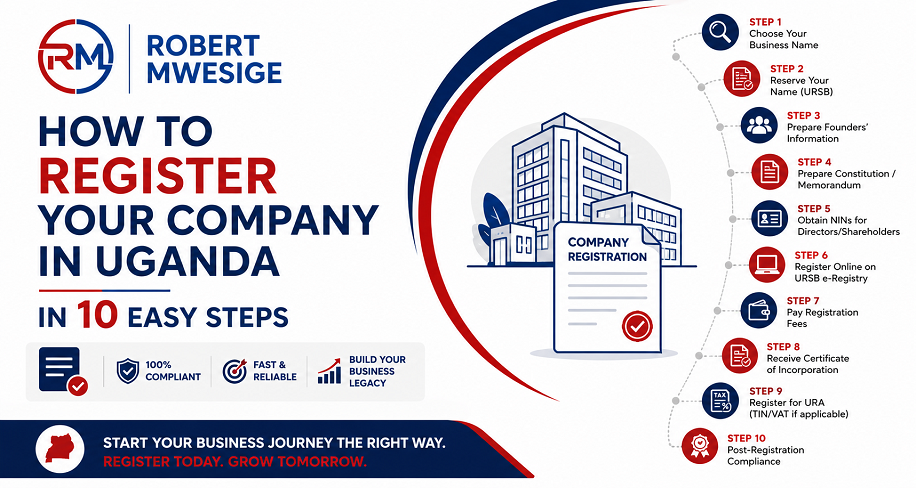
Executive Summary: Statutory Registration Workflow Overview
Step 1: URSB Name Reservation
Authority: URSB e-Registry Portal.
Deliverable: System Tracking Number and Reservation Approval.
Compliance: Verify name uniqueness, 30-day reservation validity.
Step 2: Statutory Documentation & Filings
Authority: Registrar of Companies Uganda.
Deliverable: Form S18, Form A1, MEMARTS, Form 20, Beneficial Owner Form.
Compliance: Correct execution, independent witnessing, physical uploads.
Step 3: Statutory Fee Payments
Authority: Commercial Bank / Payment Gateway.
Deliverable: URSB PRN payment reference number generation.
Compliance: Payment of stamp duty, registration, and filing fees.
Step 4: Registered Postal Address
Authority: Posta Uganda (ePosta Platform).
Deliverable: URSB Form 18 (Notice of Registered Address).
Compliance: Physical or virtual post office box stamped by Posta Uganda.
Step 5: Corporate Tax Registration
Authority: Uganda Revenue Authority (URA).
Deliverable: Non-individual TIN registration Uganda.
Compliance: Corporate tax compliance, director TIN linking, email validation.
Step 6: UIA Investment Licensing
Authority: Uganda Investment Authority (UIA).
Deliverable: Investment License Certificate.
Compliance: Capital threshold ($50k local, $250k foreign investors).
Step 7: Municipal & KCCA Trading License
Authority: KCCA / Municipal Council.
Deliverable: Local Trading Permit / District Trading License.
Compliance: Property inspection, COIN generation, trade fee payment.
Step 8: NSSF Employer Registration
Authority: National Social Security Fund (NSSF).
Deliverable: NSSF Employer Registration Number.
Compliance: OctoPas portal setup, 10% employer / 5% employee contribution.
Step 9: Corporate Banking & Seal
Authority: Commercial Bank & Authorized Seal Maker.
Deliverable: Official Embossed Seal & Active Corporate Account.
Compliance: Embossed metal die seal, registered powers of attorney.
Step 10: Secondary Clearances
Authority: PPDA, Ministry of Gender OSHMIS, PAU NSD.
Deliverable: e-GP Registration, Workplace OSH Certificate, NSD Listing.
Compliance: e-Procurement account, workplace safety notice, oil sector listing.
Frequently Asked Questions Prior to Registration
What are the requirements to register a company in Uganda?
To complete business registration in Uganda, you need a reserved company name, a clear business objective, full details of directors and shareholders, National Identification Number (NIN) verification for Ugandan citizens, valid passport copies for foreign nationals, a physical registered address, an official postal address, executed Memorandum and Articles of Association Uganda (MEMARTS), and completed URSB statutory forms including Form S18, Form A1, Form 20, and the Beneficial Owner Form.
How long does it take to incorporate a company in Uganda?
With the central URSB online registration system via the e-Registry Portal Uganda, managed by the Uganda Registration Services Bureau (URSB), name reservation takes 24 to 48 hours. Formal company incorporation in Uganda takes between 2 and 5 business days upon successful payment and submission of flawlessly executed documents.
Can a foreigner register a company in Uganda without a Ugandan partner?
Yes. Under the Companies Act 2012, foreign investors can retain 100 percent equity ownership in a private company limited by shares in Uganda without requiring a local citizen partner, provided they adhere to immigration, tax, and investment threshold requirements.
How much stamp duty is paid for company incorporation in Uganda?
Stamp duty assessment in Uganda is calculated at 0.5 percent of the company nominal capital structure, subject to statutory minimum thresholds established by the Ministry of Finance, Planning and Economic Development under the Stamps Act.
Can one person register a limited liability company in Uganda?
Yes. The law explicitly allows for SMC company registration in Uganda, enabling a Single Member Company URSB structure where a single individual or corporate entity serves as the sole shareholder and director.
Step 1: Pre-Registration Phase and URSB Name Reservation via the e-Registry Portal
Before starting the digital form wizard on the URSB e-Registry Portal, every promoter must check and reserve their proposed company name. This initial step prevents trademark conflicts and ensures the proposed business title complies with statutory standards under Section 36 of the Companies Act 2012.
To begin, visit the official website at eregistry.ursb.go.ug to complete your e-Registry account creation. The e-Registry Portal Uganda serves as the modern single digital window for all corporate affairs in the country. Once logged in, navigate to the search module to conduct a URSB name search and confirm that your desired name is available. The system searches registered databases to confirm that your name is neither identical nor confusingly similar to an existing entity.
Upon verifying availability, submit a formal application for URSB name reservation through the portal. The system calculates the required URSB company registration fees for name reservation and generates a payment reference number. After making your payment at an authorized bank or via mobile money, the Registrar of Companies Uganda approves the reservation. This process locks the name for your exclusive use for up to 30 calendar days and assigns a system tracking number to your profile.
Selecting Your Corporate Entity Structure
Private Company Limited by Shares
Standard structure for commercial enterprises, capping shareholder liability at the unpaid amount on held shares.
Single Member Company (SMC)
Designed for individual entrepreneurs who wish to maintain full ownership while enjoying limited liability protections.
Company Limited by Guarantee
Primary legal framework used when registering an NGO or charity company in Uganda where members act as guarantors.
Foreign Company Branch Office
Legal path to register a foreign company in Uganda seeking to establish a non-independent corporate presence.
Business Name Registration
Designed for sole proprietorships or partnerships where full unlimited personal liability applies.
Step 2: The e-Registry Portal Registration Form Wizard and Statutory Filings
Once your name reservation is successfully approved, log into your portal account to initiate the formal limited liability company setup in Uganda. The e-Registry Portal Uganda guides applicants through a structured digital registration form wizard that generates all required statutory documents.
Key Statutory Pillars & Documentation Overview
Hover or tap any card below to reveal complete statutory details and filing obligations:
1. Application & Capital (Form S18 & Form A1)
Form S18 serves as the primary application under the Companies Act 2012 detailing nominal capital, physical address, and subscribers.
Form A1 declares share capitalization under the Stamps Act, requiring director signatures on the right and independent witnesses on the left.
2. MEMARTS & Board Particulars (Form 20)
MEMARTS establish internal governance, object clauses, and shareholder boundaries.
Form 20 notifies initial appointment of directors and secretary. Leave page 1 undated as statutory appointment is effective upon Registrar approval.
3. Beneficial Ownership (Form 1)
Mandates complete transparency regarding ultimate controlling individuals holding significant voting rights or board appointment privileges.
Requires passport/NIN verification and residential physical address mapping in compliance with anti-money laundering laws.
4. Tax Registration & URA Compliance
Non-individual TIN allocation via URA web portal required for banking, clearing imports, and municipal licensing.
Enrolls company for corporate tax compliance, PAYE withholdings, and Value Added Tax (VAT) obligations.
5. Postal Address & ePosta Setup
Mandatory physical or virtual postal box acquisition via Posta Uganda ePosta portal under Section 116 of Companies Act 2012.
Produces stamped URSB Form 18 (Notice of Registered Address) to guarantee legal summons delivery.
6. Secondary Clearances & Licensing
Includes KCCA Trading License, NSSF 15% monthly employee savings, PPDA e-GP supplier portal listing, and OSHMIS workplace inspection safety certificates.
Oil sector providers require National Supplier Database (NSD) listing via Petroleum Authority of Uganda.
Step 3: PRN Generation and URSB Statutory Fee Payment
After uploading your completed statutory forms, submit the digital application package for assessment. The e-Registry Portal automatically performs a fee assessment and triggers the generation of a URSB PRN payment reference number.
The cost of registering a company in Uganda consists of three statutory fee categories: stamp duty assessment calculated at 0.5 percent of nominal capital, standard URSB company registration administrative fees, and statutory filing fees for forms including Form S18, Form A1, URSB Form 20, and MEMARTS.
Applicants can complete payment through commercial banks, electronic funds transfers, credit cards, or mobile money platforms. Once satisfied, the Registrar issues an official electronic Certificate of Incorporation Uganda bearing a secure QR code and a unique Business Registration Number.
Step 4: Registered Postal Address Acquisition via Posta Uganda
Under Section 116 of the Companies Act 2012, every corporate entity in Uganda must establish and maintain a registered physical location and an official post office box for company registration in Uganda.
Posta Uganda Tariff Overview:
- Physical Letter Box: Annual rates range from UGX 120,000 (Kampala GPO), UGX 90,000 (Kampala DPOs), UGX 80,000 (Regional DPOs), to UGX 30,000–50,000 (Sub Post Offices).
- Virtual Postal Box: Individual Virtual Box is UGX 20,000/year. Company Virtual Box mirrors physical mailbox rates based on branch attachment (UGX 50,000 for Kampala SPOs, UGX 90,000 for Kampala GPO).
Upon completing payment, Posta Uganda issues a formal address allocation certificate and stamps your URSB Form 18 (Notice of Registered Address) for portal re-upload.
Step 5: Tax Identification Number (TIN) and URA Corporate Tax Registration
Following successful incorporation, your company must complete non-individual TIN registration Uganda with the Uganda Revenue Authority via ura.go.ug. A Tax Identification Number is mandatory for corporate tax compliance, opening bank accounts, customs clearing, and municipal licensing.
Supporting documentation required includes the Certificate of Incorporation, certified MEMARTS and Form 20, active director TINs, local physical address details, designated tax contact person information, bank details, and a referee with an active TIN. Download the URA Excel template, complete it, and upload it back to the portal for TIN certificate issuance.
Step 6: Securing a Uganda Investment Authority (UIA) Investment License
For foreign investors and foreign-owned entities, securing a foreign direct investment Uganda license through the Uganda Investment Authority represents a critical step for operational compliance and accessing statutory tax incentives.
Domestic Investor Capital Threshold
Minimum required capital investment threshold of $50,000 USD for local Ugandan investors.
Foreign Investor Capital Threshold
Minimum required capital investment threshold of $250,000 USD for foreign investors.
Applications are submitted through the eBiz portal at ebiz.go.ug along with a business proposal (5+ pages), land title/lease proof, financial evidence, and primary sector regulatory clearances where applicable.
Step 7: Municipal Licensing and KCCA Trading License Application
Under the Trade Licensing Act, every commercial entity operating within Uganda must obtain an active local trading permit or district trading license. For Kampala-based premises, complete a KCCA trading license application via the KCCA portal.
Generate a City Operator Identification Number (COIN), submit your application, schedule a physical inspection by municipal health and environmental officers, pay the assessed fee at an authorized bank, and receive your official Trading License Certificate.
Step 8: Mandatory NSSF Employer Registration and Employee Provident Setup
Pursuant to the National Social Security Fund Act (Cap 222), every business entity operating in Uganda that employs one or more individuals must complete NSSF employer registration in Uganda within 30 days of hiring staff via the OctoPas NSSF portal.
Statutory NSSF Contribution Breakdown:
- Employer Contribution: 10 percent of the employee’s total gross monthly salary.
- Employee Contribution: 5 percent deducted directly from gross monthly salary.
- Total Monthly Remittance: 15 percent sent to the NSSF fund by the 15th day of every calendar month.
Step 9: Corporate Seal Fabrication, Powers of Attorney, and Corporate Banking
Section 117 of the Companies Act 2012 mandates that every company incorporated in Uganda maintain an official corporate seal. Engage a verified company seal maker in Kampala to manufacture an embossed metal die seal engraved with your legal name.
To open a corporate bank account, present certified copies of the Certificate of Incorporation Uganda, MEMARTS, Form 18, Form 20, Corporate TIN Certificate, trading license, board resolution authorizing account opening, director IDs/TINs, verified postal box, and the official company seal.
Step 10: Secondary Clearances and Post-Incorporation Statutory Compliance
PPDA e-GP Procurement
Register on the e-GP Uganda system via egpuganda.go.ug to compete for public government procurement tenders.
Workplace OSH Registration
Serve written notice to the Commissioner for Occupational Safety and Health via oshmis.mglsd.go.ug prior to workplace opening.
PAU National Supplier Database
Entities supplying the oil and gas sector must apply via pau.go.ug to list on the National Supplier Database (NSD).
Comprehensive Guide to Business Name Registration in Uganda
For sole proprietors and partnerships seeking a simpler entity framework before transitioning to a full corporate structure, registering a business name represents a fast, cost-effective alternative:
1. Log Into URSB Portal
Access the e-Registry Portal at eregistry.ursb.go.ug using personal credentials.
2. Conduct Name Search Query
Verify that your proposed business name is unique and currently available.
3. Complete Application & NIN Verification
Provide owner identity details, NIN verification, physical business address, and activity codes.
4. Fee Payment & Certificate Issuance
Generate a PRN for the statutory UGX 35,000 fee and download your Certificate of Registration upon approval.
Summary of Registrar Compliance Rules for Online Business Registration Uganda
To avoid administrative delays and prevent your application from being queried by the URSB Registrar on the e-Registry Portal, strictly adhere to these compliance rules:
Physical Execution & Contact Signatures
Ensure every downloaded form is physically signed before scanning. A Director or Secretary must sign the contact details form.
Form A1 Signing Sides
Director, Officer, or Advocate signs on the right-hand side; the independent witness signs on the left-hand side.
Independent Witnessing & Corporate Seals
Witnesses for MEMARTS and Form A1 must be independent third parties. Affix corporate stamps/seals for corporate subscribers.
Form 20 Date & Beneficial Ownership
Leave the date on page 1 of Form 20 completely blank during initial filing. Ensure full consistency across Form 1 voting rights declarations.