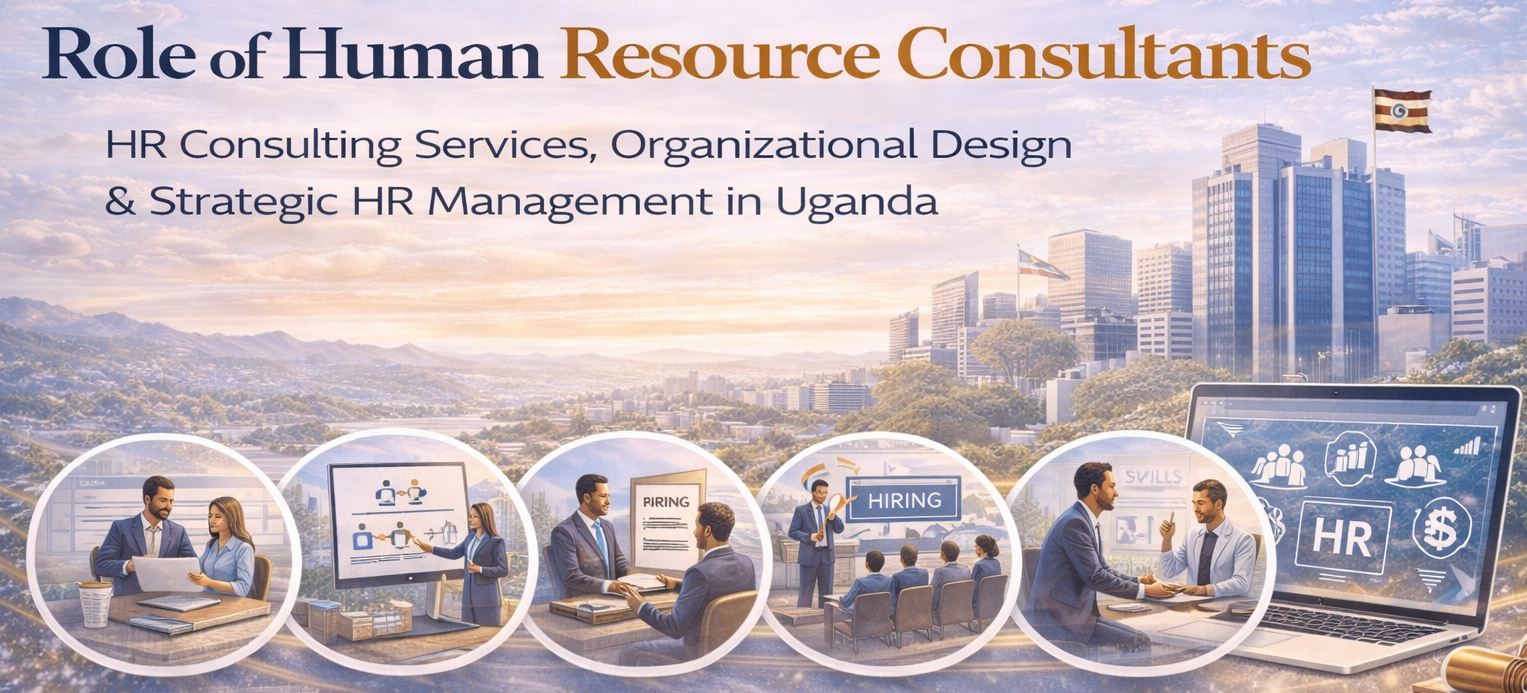
In the midst of Uganda’s rapidly evolving economy, businesses are constantly navigating intense competition and shifting market dynamics.
Human Resource (HR) consultants have become vital strategic allies for leadership teams, playing a crucial role in defining people strategies and organizational structures.These specialists provide essential guidance to CEOs and managers on everything from talent acquisition and regulatory compliance to cultural development.For instance, consultants frequently lead strategy workshops and
talent alignment sessions to ensure that internal structures and workflows are perfectly synced with overarching business objectives. By blending international best practices with deep local knowledge,
HR consultants enable Ugandan enterprises to cultivate resilient teams and high-performance environments.
The Economic Context: Formal vs. Informal Sectors
Understanding the impact of
HR consultancy requires a look at Uganda's unique labor landscape:
| Sector | Workforce Size | Percentage |
| Formal Sector (Services & Industry) | 2.3 million | 15% |
| Informal Economy | 13.3 million | 85% |
While the formal sector accounts for a smaller share of the workforce, it is the primary driver of
investment and economic growth. These businesses rely heavily on sophisticated
HR systems and skilled talent to remain competitive.
Empowering SMEs and Startups
Many Small and Medium Enterprises (SMEs) and startups in Uganda operate without dedicated in-house HR departments. Industry data suggest that entrepreneurs often lose 2 to 3 days every month managing routine payroll and compliance obligations.By stepping in to manage these critical functions,
including tax filings, recruitment, and payroll administration, an
HR consultant allows business leaders to reclaim their time and refocus their energy on strategic expansion and scaling.Furthermore, a recent survey by the
International Labor Organization (ILO) and the Federation of Uganda Employers found that the COVID-19 pandemic reshaped workplace practices. About 28% of employees worked remotely during the pandemic, and many Ugandan enterprises now embrace hybrid models.
HR consultants have been instrumental in guiding this transition,
helping firms implement flexible policies, digital systems, and safety protocols. Nearly half of the surveyed businesses reported that pandemic-driven changes (such as health measures and remote work) improved efficiency.In the years ahead,
skilled HR partners will continue helping Ugandan companies adapt – from redesigning office layouts for safety to reframing performance metrics (93% of firms plan to measure productivity by output).Together, these factors a youthful but fragmented labor pool, evolving regulations, and a shifting work environment make
HR consulting a vital service in Uganda. The following sections explore 15 core areas where HR consultants add value by combining strategic guidance with local expertise. Each pillar is explained in turn, with Ugandan context and examples to illustrate how
consultants support organizational success.
1. Organizational Structure Redesign
Overview: Organizational design is about arranging jobs, teams, and reporting lines so a company can achieve its goals. In Uganda, fast-growing businesses or projects often outgrow their initial charts.An
HR consultant analyzes the existing structure and proposes a new framework that fits the strategy. This may involve creating new departments (e.g., a compliance or digital unit), flattening hierarchies, or realigning roles for efficiency.
Consultant’s role
The consultant begins by mapping the current organization (roles, responsibilities, workflows). They interview leaders to understand strategic goals. Then they draft a new org chart, redefine roles, and prepare job descriptions. For example, a mid-sized Ugandan telecom might shift from a regional sales structure to a product-based structure as it diversifies services. The consultant ensures clarity in reporting lines and minimizes overlaps or gaps.Uganda’s economy is sector-diverse – from agriculture to tech – so structures vary widely.
Consultants often help public-sector projects (e.g., a Ministry needing to reorganize) as well as NGOs and private firms. They use local knowledge about typical company sizes and management styles. For instance, family-owned businesses may need separation of family roles from operations;
consultants provide neutral, professional viewpoints.
Key benefits
A lean, well-defined structure improves decision-making speed and accountability. Employees clearly know their supervisors and peers. Restructuring often leads to better use of resources (e.g., shared HR or finance teams) and can reduce costs. It also prepares companies for growth: a well-designed organization can onboard dozens of new hires or expand into new regions without chaos.
Example: Imagine a rapidly expanding Kampala startup that started with a flat team of ten. After securing investment, it must double its staff and enter new markets. An
HR consultant might introduce mid-level managers and specialized departments (e.g., separate marketing vs. tech teams) to prevent future confusion.In summary, organizational redesign means aligning people and roles with business strategy.
HR consultants bring a holistic view, applying both management theory and on-the-ground knowledge of Ugandan workplaces to ensure the revamped structure is practical and sustainable.
2. Executive Search & Headhunting
Executive search (or headhunting) is a specialized form of
recruitment for senior roles. In Uganda’s tight talent market, finding high-level managers is challenging. Many top candidates are not actively job-seeking, so consultants must network deeply. An
HR consultant helps clients identify and attract the right executives to fit the company’s vision.
Consultant’s role
The consultant works closely with the board or CEO to define the candidate profile: required skills, experience, and even personal attributes (such as industry reputation or cultural fit). They then tap into
professional networks. In Kampala, this often means leveraging contacts within trade associations, alum groups, and the social circles of business leaders. The consultant discreetly approaches potential candidates. Ugandan headhunters report that success often comes through referrals and relationships. They conduct initial screening and set up interviews. Once a shortlist is ready, the client meets the candidates. The consultant may also advise on compensation packages to entice a top executive.Uganda’s executive talent pool is relatively small for some sectors (e.g., tech leadership is nascent). Thus,
headhunters sometimes look regionally (Kenya, Rwanda) or among returnee professionals.However, local culture matters: Ugandan business leaders often rely on trust and existing connections. Experienced HR consultants know key figures – for example, leaders at banks, telecoms, or large NGOs – and can tap those networks. They also vet candidates carefully; for sensitive positions, due diligence (background checks and reference calls) is crucial in Uganda’s context.
What are the Benefits?
A professional executive search speeds up hiring and improves quality. Filling a CEO, CFO, or country manager role quickly can be critical. According to a regional HR consultancy, recruitment outsourcing can
“reduce hiring cycles by 40–60%,” freeing leaders to focus on business. Executive search firms also help negotiate terms and ensure a smooth transition for the new hire. For example, they might assist with relocation logistics if the candidate comes from abroad, which is
common in international NGOs.
Pitfalls
On the flip side, Ugandan organizations should beware of over-reliance on personal referrals (which can reinforce homogeneity). A consultant mitigates this by casting a wide net. They may also caution clients about poaching from competitors, which can lead to legal or relational issues.In practice, hiring a top manager in Uganda often requires both skill assessment and cultural judgment.
HR consultants bring industry knowledge and objectivity to this process, ensuring that C-suite searches succeed in the local environment.
3. Employee Value Proposition (EVP) Design
Overview: The Employee Value Proposition (EVP) is the unique set of rewards and benefits that attract and retain employees.
An HR consultant helps define and communicate this proposition to help the company stand out as an employer. In Uganda, where competition for skilled workers (especially in tech, finance, and NGOs) is growing, a clear EVP is crucial.
Consultant’s role
The consultant surveys current employees to understand what they value (e.g., career development, good pay, work-life balance). They also research market standards. In Uganda, this might include examining typical benefits across industries: for instance, many firms offer transport or housing allowances, health insurance, and end-of-year bonuses.With this information, the consultant helps craft an EVP statement that highlights the company’s unique strengths (such as flexible hours,
training opportunities, or a strong social mission). The consultant may advise revamping branding, e.g., upgrading the company's careers page, and
training managers to sell the EVP during interviews.Cultural factors influence EVPs in Uganda. For example, family and community ties are strong, so employees often value family-friendly policies (such as support for schooling or recognition of major cultural events). Health insurance and housing are also very attractive perks in Kampala’s urban environment. A consultant knows that what motivates staff in a Kampala office might differ from what motivates those in a rural field office; EVP design can be tailored accordingly.
Exploring the Benefits
A compelling EVP improves hiring and retention. For Ugandan companies competing against
multinationals or NGOs, highlighting local relevance (such as contributing to Uganda’s development) can attract patriotic talent. It also boosts morale: if employees feel their values align with the company’s, engagement rises. As
one HR expert notes, engaging employees requires that they “feel their contributions are recognized and they have a clear path for growth” – all part of a strong EVP.
Example: Consider a software startup in Kampala. An
HR consultant might discover that younger employees crave learning opportunities. The consultant could then position the company as a “training hub” in its EVP, emphasizing mentorship programs and paid courses. This distinct messaging helps the startup stand out when recruiting developers.By designing and refining the EVP,
HR consultants ensure Ugandan organizations present themselves as employers of choice. This is especially important in sectors like finance or telecom, where local talent may otherwise be drawn to bigger, international players.
4. Performance Management System Implementation
Overview: Performance management involves setting goals, monitoring progress, and giving feedback. In many Ugandan companies, formal appraisal systems are weak or absent.
HR consultants help introduce or revamp performance management systems (PMS) that fit the local context, turning “manager’s gut feeling” into structured processes.
Consultant’s role
The consultant assesses existing practices – perhaps annual reviews are ad-hoc, or key performance indicators (KPIs) are undefined. They then work with leadership to define clear, measurable objectives for each role.For example, a sales team might get monthly revenue targets; an NGO’s program officer might have targets for project milestones. The consultant chooses tools (paper-based or digital) to track performance. They often train managers to give constructive feedback and conduct appraisals fairly. A phased rollout is common: start with pilot teams, adjust the process, and then scale it across the company.Managers in Uganda sometimes hesitate to criticize staff directly, valuing harmony. A
consultant can coach them on delivering feedback in culturally sensitive ways. Also, given that work is often team-oriented, consultants may integrate peer feedback or group review sessions. Ugandan labor culture values respect and personal relationships; performance conversations may be blended with career counseling rather than being purely evaluative.
Benefits
A proper PMS aligns employees with business goals and motivates improvement. Studies show that organizations that implement continuous feedback loops see higher engagement. In Uganda specifically, a lack of clarity on evaluation often leads to demotivation.As one local HR analysis noted, “without a
structured performance management system, ... employees feel their contributions are not recognized, and they lack a clear path for career growth”. By introducing regular check-ins and reward mechanisms, consultants help mitigate these issues. Modern PMS also ties performance to incentives, so top performers receive bonuses or promotions, reducing turnover.
Aligning with changes: Notably, the pandemic has shifted focus to output rather than hours. According to the ILO/FUE survey, 93% of Ugandan firms plan to focus on outputs as the key productivity measure in the future. An HR consultant helps design performance metrics accordingly, emphasizing deliverables over mere office attendance.
Implementing a performance management system is often challenging, but consultants bring structure and neutrality to the process. They ensure the system respects Ugandan workplace norms while introducing accountability. Done well, it transforms employee appraisals from a yearly ritual into an ongoing conversation that drives organizational excellence.
5. Compensation & Benefits Benchmarking
Overview: Compensation benchmarking means comparing pay and benefits against the market.
HR consultants conduct salary surveys and market research so companies in Uganda offer competitive, fair compensation packages. This covers base pay, bonuses, allowances (housing, transport), benefits (medical insurance, retirement contributions), and non-monetary perks.
Consultant’s role
The
consultant gathers data on industry pay scales. In Uganda, reliable public salary surveys are scarce, so consultants often rely on a combination of published reports (e.g., from the government or NGOs) and proprietary data from local HR associations. They also consider geography: Kampala rates are generally higher than in other regions. Based on this, the consultant helps set salary bands for each role level.They ensure compliance with statutory requirements, for instance, mandatory pension contributions to the National Social Security Fund (NSSF) and Pay-As-You-Earn (PAYE) tax deductions must be correctly factored. The consultant also reviews benefits, such as leave entitlements and meal allowances, to ensure they align with legal minimums and industry norms.Uganda has an official minimum wage only in select sectors (e.g., sugar, coffee), but generally open pay rates. Still, employers face public scrutiny if disparities are too wide. Consultants must be sensitive: for example, being transparent about salary ranges can be delicate in local culture.Also, due to inflation and cost-of-living changes, periodic re-benchmarking is often needed. Notably, in 2023, the Uganda Revenue Authority (URA) increased enforcement, penalizing companies for late PAYE/NSSF filings.
A consultant ensures payroll systems integrate these deductions accurately.
Benefits packages
Beyond salary, consultants look at the full package. In Kampala, housing or car allowances are common among mid- to senior-level staff. Health insurance contributions (private schemes) are standard among larger firms. Consultants advise on what to include, such as tuition support for an employee’s children or gym memberships, if that aligns with company culture. Crafting a package that balances cost and appeal is key.
Pitfalls
Mispriced compensation can lead to staff turnover or resentment. An HR consultant warns that if salaries are below market, talent might flee to competitors or NGOs. Conversely, overpaying too early can strain budgets. By providing data-driven benchmarks, consultants help companies strike the right balance.In short,
compensation benchmarking by HR consultants brings professionalism to pay decisions. It helps Ugandan organizations attract qualified talent while ensuring equitable treatment of employees.
6. HR Policy & Employee Handbook Development
Overview: Every firm needs clear
HR policies (written guidelines on leave, code of conduct, etc.) and an employee handbook. In Uganda,
HR consultants write or update these documents to ensure legal compliance and consistent enforcement of rules.
Consultant’s role
The consultant reviews existing policies (if any) and identifies gaps. Using local labor law as a base,
they draft an employee handbook tailored to the client. For example, Ugandan law mandates specific things: working hours, leave entitlements, termination notice periods, etc.The handbook will cover all this: workweek limits, overtime pay rules, annual leave, maternity leave, sick leave, etc. The consultant also advises on grievance procedures (since employees have the right to a fair hearing upon dismissal) and on anti-discrimination clauses.Once drafted, they often workshop the policies with management to ensure understanding. Some policies, such as disciplinary steps, may require
training sessions to ensure managers apply them uniformly.Ugandan employment laws are largely derived from the Employment Act 2006. Key provisions include a maximum of 48 hours per week (8 hours per day) and detailed leave rules. For instance, after 12 months of service, an employee is entitled to 21 working days of paid annual leave. Female workers are guaranteed 60 days of paid maternity leave (and often take the full 4 months, as per customs).Consultants ensure all such statutory benefits are clearly stated. Uganda has no general minimum wage, but firms in some industries follow government or union guidelines, which the consultant can incorporate if relevant.
Additional policies
Consultants also draft company-specific policies. For example, they might establish rules for internet use, remote work, or social media, which are becoming important in Kampala’s office culture.Given the pandemic experience, remote work policies are now often included in employment contracts. If the firm deals with international funding, there may be compliance policies (anti-bribery, conflict of interest) that need to be translated into local practice.
The Benefits: A well-crafted handbook protects both employer and employee. Workers in Uganda, as elsewhere, feel more secure when they know their rights (such as a fair termination process) and obligations. For management, clear policies prevent confusion and help defend against legal issues.
HR consultants bring best practices while adapting language to local norms (for example, using respectful tone and local examples).
Pitfalls
Drafting policies in Uganda requires cultural sensitivity. For instance, conflict-of-interest rules must account for the prevalence of extended-family employment. Consultants avoid overly harsh language and often include a preamble about mutual respect. When policies are introduced, they should be communicated (sometimes in local languages), so employees truly understand them.In summary,
HR consultants play a vital role in policy development. They translate Ugandan labor laws and corporate values into clear handbooks, ensuring that growing businesses in Kampala and beyond operate fairly and in compliance with the law.
7. Leadership Coaching & Development
Overview: Strong leadership is critical for any organization.
HR consultants often serve as executive coaches or
trainers for managers,
building leadership skills and succession pipelines. In Uganda, as companies grow and new managers emerge, coaching becomes more important.
Consultant’s role
The consultant may coach individuals (such as newly promoted managers) or design group leadership programs.
One-on-one coaching might involve working with a CEO or head of department on communication skills, strategic thinking, or change management. Group sessions could include workshops on team leadership, conflict resolution, or diversity.Consultants frequently use 360-degree feedback tools to help leaders understand how peers and subordinates perceive them. After feedback, they set development plans for each leader. For example, a bank might have a series of seminars on “leading through change” facilitated by the consultant.
Ugandan leadership development often blends global concepts with local culture. For instance, in Uganda (and many African contexts), respect for authority is traditionally high, but younger managers also expect empowerment. A consultant helps leaders balance these aspects, being approachable while maintaining discipline.Moreover, many Ugandan managers value practical guidance. Consultants might include case studies relevant to Uganda (e.g., how a regional telecom succeeded) or draw on local business stories. Notably, several
top HR leaders in Uganda emphasize continuous learning:
Milton Owor (CPG at NSSF) and Joyce Kasirye (UCC) are known for developing HR strategy and supporting talent, reflecting a national trend towards leadership development.
Benefits package
Investing in leaders has a cascading impact. Well-coached managers can better motivate their teams, make sound decisions, and navigate crises (such as market shifts). Employees often report higher engagement when their supervisors show leadership competence. As HR experts point out, cultivating a high-performance culture starts “at the top” – leaders set examples and uphold standards.
Example: A manufacturing firm in Jinja may have senior managers with strong technical skills but limited formal leadership training.
An HR consultant could help them transition to a more strategic focus, perhaps by conducting simulations or mentorship programs.In sum,
leadership coaching by
HR consultants raises the capability of Uganda’s management cadre. It is an investment that pays dividends in improved organizational resilience and people engagement.
8. Learning & Development (L&D) Strategy
Learning & Development provides training to build staff skills and knowledge. HR consultants craft L&D strategies that align with a company’s goals, determining which training programs are needed, how to deliver them, and how to measure their impact.
Consultant’s role
The consultant starts with a training needs analysis. They interview managers and review performance data to identify skill gaps. For instance,
a Ugandan NGO might need proposal-writing workshops, while a tech firm may require cybersecurity training.The consultant then sources or designs programs: this might involve partnering with local providers (e.g., Makerere University Business School, Uganda Management Institute,
Inverness Consulting Group, or private trainers) or organizing in-house sessions.They may also
recommend online platforms for continuing education. Crucially, the HR consultant ensures training budgets are spent on priority areas and may arrange scheduling to avoid disrupting operations. Post-training, they track metrics (like test scores or productivity improvements) to justify ROI.The training ecosystem in Uganda includes government-sponsored programs and donor-funded workshops (e.g., under UN or EU projects). A savvy consultant knows how to leverage these (for example, securing staff slots in a partially funded leadership course) while filling gaps with paid solutions. Language can be a factor; English is the official business language, but for some technical or practical skills, local-language instruction (e.g., Luganda or local dialects) may increase uptake.
Consultants accommodate this when planning programs.
What are the Benefits
A strategic L&D approach builds a learning culture. Employees see that the organization invests in their growth, boosting morale and retention. It also helps with succession planning: by
training mid-level staff, companies create a pipeline of future leaders. For example, if a
consultant identifies that sales teams lack digital skills, targeted training can improve the company’s competitiveness.
Example: A consultant might help an agricultural exporter implement a graduate trainee program, hiring new graduates and systematically rotating them through departments with structured training, a model borrowed from large African enterprises.Ultimately, L&D ensures that a Ugandan company’s workforce evolves with changing business needs. In a country where skill shortages (especially in STEM fields) can be acute,
HR consultants play a key role in bridging gaps through thoughtful training and development planning.
9. Talent Management & Succession Planning
Talent management is about identifying, developing, and retaining high-potential employees. Succession planning, a subset of talent management, prepares for future leadership transitions. HR consultants implement frameworks, so Ugandan companies always have the right people ready to step up.
Consultant’s role
The consultant helps build talent pools. They work with leaders to identify critical roles (e.g., technical experts or key salespeople) and potential successors for each role. This might involve talent reviews or performance matrices. For high potentials, consultants design fast-track development programs (perhaps assigning them a mentor or special projects). They also advise on retention strategies, for example, personalized career plans or incentives for key staff. In larger firms, the consultant may set up a structured succession process tied to performance appraisals.In Uganda, family-owned firms or founder-led organizations often face succession challenges.
External HR consultants can provide an objective perspective they might privately assess whether a family member is the best choice to succeed the founder, or propose alternatives. In multinationals (such as telecoms or banks), succession planning is often mandated by corporate policy; the consultant ensures that local managers understand and follow these global processes. For SMEs, a consultant might recommend having at least two people trained for each major function to avoid single points of failure.
Benefits: Good
talent management reduces business risk. If a key employee leaves (for example, an engineer joining an overseas project), a company with succession plans can quickly move in a trained backup. It also motivates ambitious employees who see a clear career path. Especially in Uganda’s competitive job market, showing that the firm develops people internally can attract talent.
Pitfalls
Without careful handling, talk of “succession” can alienate existing managers who feel overlooked. Consultants manage this by keeping processes confidential and emphasizing developmental opportunities rather than imminent replacement.In brief, talent management is about building for the future. An
HR consultant ensures Ugandan businesses are not caught off guard when top performers move on; instead, they have a plan to ensure operations and leadership continue seamlessly.
10. HR Business Partner (HRBP) Model Integration
The HR Business Partner model embeds HR professionals within business units, making them strategic advisors rather than just administrators. In Uganda, companies are increasingly adopting this model to ensure HR solutions are closely aligned with each division’s needs.
Consultant’s role
An
HR consultant may help design and implement the HRBP framework. This involves defining roles: for example, assigning experienced HR staff to work with the finance team, operations team, etc. The consultant trains those HRBPs to understand business metrics (e.g., sales growth or project timelines) and to participate in management meetings. They also set performance goals for HR staff based on business outcomes rather than on HR tasks alone. For a transition, the consultant might run pilot programs – e.g., one department works with a dedicated HR advisor for six months.This model is still emerging in Uganda’s private sector. However, some leading companies have adopted it. For instance,
Stanbic Bank Uganda has integrated HR partners across its divisions, and its Head of People & Culture, David Mutaka, emphasizes the need to link HR strategy to banking products. Similarly,
large NGOs and international donors often expect HRBPs who understand project funding cycles. The consultant uses these examples to illustrate the model’s benefits to local clients.
The Benefits
When HR staff truly know a department’s challenges, they can tailor interventions (hiring, training, engagement) more effectively. This boosts trust: managers see HR as one of their team rather than an external bureaucracy. Over time, HRBPs can predict business needs, such as when new skills will be required for expansion.
Challenges
Shifting to an HRBP model requires change: HR generalists must become business-savvy. A consultant addresses this by conducting role-plays, workshops, and coaching HR personnel on the new mindset.By integrating HR as a business partner, organizations in Uganda ensure that
human capital planning keeps pace with company strategy. It moves HR from being just a “personnel department” to a driver of organizational performance.
11. Employee Engagement & Culture Building
Employee engagement and company culture are about how connected employees feel to the organization and to each other. In Uganda, where work relationships often extend beyond the office (family, church, community bonds), cultivating a positive culture is essential.
HR consultants help assess and improve engagement, creating workplaces where staff are motivated and aligned with company values.
Consultant’s role
First, the
consultant may conduct engagement surveys or focus groups (in the appropriate language). Questions might probe trust in management, alignment with vision, and satisfaction with the work environment. Based on the results, the consultant devises action plans: this could include
team-building retreats, town hall meetings, or recognition programs. They also advise managers on inclusive leadership, for example, celebrating local holidays or acknowledging staff achievements publicly.Ugandan employees often expect personal respect and a sense of belonging at work. An
HR consultant might, for instance, organize mentorship circles that mirror extended-family support. When possible, consultants bring in local examples, highlighting successful culture initiatives at Uganda Breweries or Centenary Bank (both have been recognized for HR excellence). Diversity and inclusion are other aspects of Uganda: it has multiple ethnic groups and languages, so
consultants encourage multicultural events or sensitivity training.
The Benefits
Higher engagement leads to better retention.
Research in Uganda and elsewhere shows that engaged staff produce higher-quality work and are more likely to go the extra mile. Importantly, the COVID-19 context taught Ugandan businesses about communication: 80% of enterprises reported engaging in
regular dialogue on health and safety during the pandemic. Consultants build on this by establishing ongoing channels (such as newsletters, suggestion boxes, or apps) for employee feedback.
Example: A rural healthcare
NGO in Uganda might have staff scattered across districts. An
HR consultant could implement quarterly “culture days” in which staff from different regions gather (virtually or in person) to share successes and training. This fosters a unified culture despite geographic distances.By systematically addressing engagement,
HR consultants help ensure Ugandan companies aren’t just attracting talent, but keeping it. In turn, a strong workplace culture supports productivity and innovation.
15. Change Management Facilitation
Change is inevitable – whether it's a new system implementation, a merger, or a shift in strategy.
HR consultants guide organizations through transitions smoothly. They apply change management techniques to minimize disruption and gain employee buy-in.
Consultant’s role
The consultant acts as a change agent. When a major change is planned (say, a new HRIS rollout, policy overhaul, or a company merger), the consultant first assesses potential impacts on people and processes.They
create communication plans (e.g., explain the “why” of change to staff), training for new tools or workflows, and feedback channels. During implementation, the consultant monitors progress and addresses resistance. For example, if staff are reluctant to use new software, the
consultant might organize hands-on help sessions or adjust timelines based on feedback.In Uganda, changes are sometimes met with caution due to the value placed on stability and trust. Consultants take care to involve local leaders as change champions. For instance, a respected department head may be enlisted to endorse the change.The ILO/FUE study noted that many Ugandan enterprises “rethought how they measure productivity” and accelerated digital adoption during the pandemic. Consultants leverage such positive experiences: if employees saw benefits from video meetings or digital tools during COVID, that momentum can help drive further changes (like a full HR software implementation).
Benefits
Proper change management keeps projects on track and ensures new initiatives stick. Poorly managed changes can cause morale drops or project failures (e.g., an HR software never getting used).
HR consultants bring structured methodologies (stakeholder analysis, feedback loops, phased rollouts) that increase the likelihood of success.
Example: Suppose a Ugandan bank decides to merge two branches and introduce a new core banking system.
An HR consultant would plan joint staff meetings explaining the vision, set up cross-branch teams to share best practices, and organize training on the new system well ahead of go-live.Change management is a cross-cutting service: it touches many of the earlier pillars (training, culture, tech). In Uganda’s dynamic environment, having an HR consultant manage change means businesses can evolve, whether reorganizing after a pandemic or embracing new market opportunities without losing their workforce’s confidence.
13. Employee Relations & Conflict Resolution
Overview: Employee relations covers handling disputes, grievances, and ensuring workplace harmony.
HR consultants often step in as neutral mediators or advisors when conflicts arise, be it interpersonal issues, union demands, or policy grievances.
Consultant’s role
The consultant may be called in to impartially investigate serious complaints (e.g., allegations of harassment). They interview parties involved, review facts, and help management arrive at fair outcomes.For broader issues, the
consultant might hold conflict resolution workshops to train managers in de-escalation. They also help set up formal grievance procedures, ensuring employees know how to raise concerns.In cases of labor unrest, the consultant advises on dialogue: although union activity in Uganda is more common in public sectors (teachers, civil servants), any company can face collective issues. The
consultant ensures compliance with labor laws in handling dismissals or negotiations, minimizing legal risks.Ugandan workplaces often have a strong hierarchical culture, which can make subordinates hesitate to voice issues.
A skilled HR consultant respects cultural norms of respect but emphasizes fairness.For example, if a family member is employed in the company, consultants must handle disputes neutrally despite cultural pressures. Additionally, in multi-cultural teams (common in larger Kampala firms), consultants promote understanding by clarifying acceptable behaviors and corporate values.
The Core Benefits
Professional handling of conflicts preserves relationships and protects the company’s reputation. It prevents small issues from escalating into strikes or lawsuits. For instance, if an employee feels unjustly passed over for promotion,
a consultant can guide HR in conducting a proper review of the situation, often involving an impartial review panel or an external mediator.
An Example
In one Ugandan NGO case (hypothetical), a field supervisor clashed with head office staff over reporting lines.
An HR consultant facilitated mediation sessions, helping each side understand the other’s challenges. Through guided dialogue, they agreed on clearer communication channels and a revised reporting structure, resolving the conflict without resorting to dismissal.Effective employee relations keep the workplace functional. In Uganda’s communal culture, resolving conflicts amicably reinforces loyalty – employees see that management cares enough to listen.
HR consultants thus act as guardians of a healthy work environment, balancing authority with empathy.
14. HR Audits & Compliance
An HR audit is a thorough review of a company’s HR policies, records, and procedures to ensure legal compliance and best practices. In Uganda, where labor laws are comprehensive, consultants conduct HR audits to uncover any compliance gaps and mitigate risk.
Consultant’s role
The consultant systematically examines employment contracts, payroll records, policy documents, and benefits administration. Key checkpoints include whether working hours and overtime are logged, if leave records match statutory entitlements, and whether payroll deductions (tax, NSSF, local taxes) are correct. They verify that mandatory insurance (workers’ compensation) is in place and that any industry-specific rules are followed.
Consultants also check compliance with health and safety regulations (for instance, ensuring a written safety policy exists if there are 20+ workers). After the audit, the consultant provides a report of findings and recommendations, ranging from corrective actions (e.g., backdating unclaimed leave) to improvements (e.g., digitizing records to improve accuracy). They may also conduct follow-up training to correct any deficiencies.Ugandan labor law has many specific requirements. For example, the Employment Act mandates a standard workweek of 48 hours (10 hours/day). The ILO reports that Uganda enforces this limit; employers must not exceed 48 hours without agreement, and overtime rules apply beyond that.
Employers must also pay PAYE, NSSF, and any local taxes for each employee. Use of casual labor is strictly regulated; work exceeding 4 months without conversion to full-time is illegal.
HR consultants ensure that all such rules are met. They might find, for instance, that an employer forgot to enroll a part-time worker in NSSF; identifying that early prevents penalties.
Benefits
An audit protects the organization from fines and lawsuits. In 2023, several Ugandan SMEs were fined by URA for late or incorrect filings. By catching errors in advance, a consultant saves money and reputation. Audits also improve data quality – accurate employee records support better planning in all other HR areas.
In short, HR audits are the backbone of HR consulting compliance. They reassure owners and investors that the company follows Ugandan laws and is a fair employer.15. HR Technology Selection (HRIS/ATS)
Human Resource Information Systems (HRIS) and Applicant Tracking Systems (ATS) are software solutions for managing HR data and hiring processes. HR consultants help Ugandan companies choose and implement these technologies to modernize their HR operations.
Consultant’s role
The consultant assesses the company’s needs: for example, does the organization need a simple payroll system, or a full HR suite with performance, training, and recruitment modules? They evaluate options from global platforms (such as BambooHR and SAP SuccessFactors) to local solutions (such as PahappaHR).Criteria include functionality, ease of use, and cost. The consultant then oversees deployment: configuring the system with the company’s data (employee details, job roles) and integrating local rules. They also
train HR staff (and often managers) to use the new platform. For recruiting, an ATS allows all applicants to be tracked in one place, a major improvement over email or paper processes. The consultant ensures that system workflows (e.g., leave requests and approvals) align with the company’s policies.Many small Ugandan firms still rely on spreadsheets or paper records. However, digital adoption is growing, especially after COVID-19 highlighted the need for remote access. The consultant ensures any
chosen HRIS supports Uganda’s legal requirements, for example, automating PAYE and NSSF calculations.In fact, one
HR software provider advertises that its system “automatically computes PAYE and NSSF contributions” in accordance with Uganda’s tax rules, ensuring compliance. Other local features include multi-currency support (for companies paying allowances in USD) and East African mobile money integration (for payroll). If internet connectivity is unreliable, consultants may recommend hybrid systems with offline capabilities.
The Benefits
The right
HR technology saves time and reduces errors. As the PahappaHR case shows, automating payroll and leave tracking frees HR staff from repetitive tasks. Employees also benefit via self-service: for instance, they can log in to apply for leave or see payslips online.For the business, data becomes transparent, and managers can run reports on headcount, turnover, or training hours instantly. This digital transformation helps Ugandan companies scale: for every additional employee, a cloud-based system can handle record-keeping without requiring additional administrative staff.
Example: A medium-sized exporter in Entebbe might implement an HRIS to manage its 200+ employees across multiple farms. The consultant works with
local IT partners to deploy the system, train farm managers on data entry (perhaps via mobile app), and set up alerts for contract renewals or certification expirations.Selecting and
deploying HR technology is an investment. With guidance, companies in Uganda can choose solutions that fit their budget and culture. The consultant’s expertise ensures the system solves real problems and leads to measurable productivity gains, rather than becoming a costly, unused tool.
Summary of the Strategic Value of HR Consultants in Uganda
In summary,
HR consultants in Uganda wear many hats, from organizational designers and talent scouts to policy writers and tech implementers. They bring specialized expertise that many growing businesses lack internally. By focusing on human capital, these consultants help clients align their workforce strategy with business goals, comply with regulations, and build a positive workplace culture.For Ugandan companies, whether a Kampala startup, a regional NGO, or an established bank, partnering with
an HR consultant can be transformative. It means faster hiring, better-trained staff, and leadership that understands how to motivate teams.As Uganda’s economy becomes more competitive (GDP growth has been about 6–7% in recent years), companies that invest in their people will have a clear advantage. HR consultants help bridge the gap between where the organization is and where it needs to go.Are you ready to strengthen your team and optimize your HR strategy? Consider engaging an
HR consultant in Uganda to begin your journey toward excellence. They can tailor solutions to the local context, ensuring your business not only grows, but does so with a strong foundation of skilled, engaged employees.
Sources: Insights and data in this article are drawn from Ugandan government reports and local
HR industry experts. These include the Uganda National Planning Authority’s Employment Report, the International Labor Organization's studies, and practical advice from
Ugandan HR service providers.