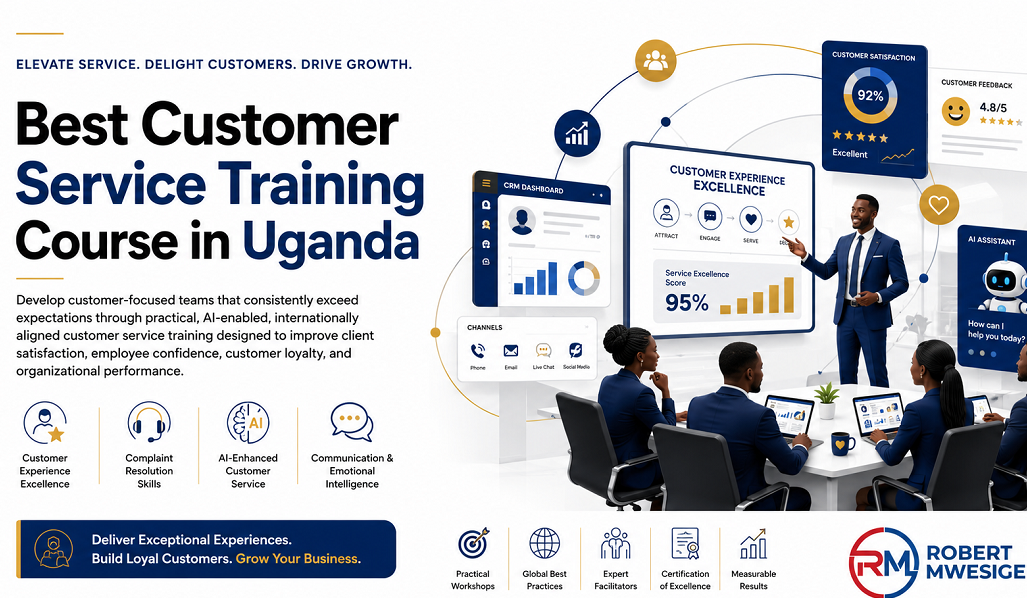
Are silent customer service blind spots leaking your revenue every single day? In Uganda’s rapidly evolving, highly competitive marketplace, technical competency is no longer enough to secure customer loyalty and protect your brand equity. Whether you run an established commercial bank in Kampala, a fast-scaling FinTech platform, a bustling retail supermarket chain, a private healthcare clinic, or a high-end luxury safari lodge in the heart of our national parks, your front-line customer experience is either your most powerful growth engine or your silent brand killer.
I am Robert Mwesige, a leading independent Customer Experience (CX) Consultant and corporate trainer based in Kampala. I specialize in designing and delivering high-impact, culturally localized customer service training in Uganda that bridges the critical gap between international service standards and the unique cultural expectations of the Ugandan consumer.
We do not believe in standard, dry, off-the-shelf academic lectures. Instead, we work collaboratively with corporate leadership to build high-performance service cultures that integrate the deep, respectful philosophy of Obuntubulamu, the local African core of humanity, empathy, and mutual respect, with the efficiency, agility, and power of modern digital tools and artificial intelligence.
What is Customer Service Training in Uganda? (The Quick Answer)
For search engines and busy HR directors looking for immediate, clear definitions, this structured summary outlines the standards of professional customer care training in Uganda:
| Feature | Service Standard & Definition |
|---|---|
| Core Objective | Transforming front-line staff from passive, transactional agents into proactive, empathetic brand ambassadors who drive long-term customer retention. |
| Cultural Pillar | Blending the local values of Obuntubulamu (humanity, empathy, and respect) with modern, automated performance frameworks. |
| Delivery Modes | Tailored in-house corporate training, short courses, local workshops, and customized digital masterclasses. |
| Key Industries | FinTech, retail, corporate banking, hospitality, tourism, telecom, healthcare, and e-commerce. |
| Primary Location | Physically based in Kampala, with nationwide delivery capabilities spanning Entebbe, Jinja, Mbarara, Gulu, Mbale, and beyond. |
| Measurable Metrics | Net Promoter Score (NPS), Customer Satisfaction Score (CSAT), First Contact Resolution (FCR), and Turnaround Time (TAT). |
The Core Cultural Philosophy of Service in Uganda
To build a genuinely world-class service culture in East Africa, we must move past foreign textbooks and tap into local realities. True customer care training in Uganda must speak directly to the hearts of your employees and your target market. My curriculum is built entirely upon this foundational cultural integration:
Obuntubulamu (Ubuntu / Humanity)
At the very center of my philosophy is Obuntubulamu—the deep cultural understanding that "I am because we are." In a customer service context, this means treating every client, colleague, and visitor with authentic dignity, empathy, and respect, regardless of their social class or purchasing power. We train teams to transition from cold, robotic interactions to warm, human connections.
The Right-Hand Rule of Local Service
In many Ugandan communities, physical etiquette carries immense weight. Handing over a product, presenting a receipt, returning balance change, or exchanging business cards using the left hand is widely perceived as highly disrespectful. We teach front-line staff to use only the right hand, or both hands combined, as a physical gesture of respect and appreciation.
The Elaborate Greeting Protocol
In the West, entering a business and immediately launching into a transaction is standard. In Uganda, this direct approach is considered rude and aggressive. We train staff to initiate every interaction with a warm, localized greeting tailored to the customer's background or the business environment. This small step sets an entirely different, positive tone for the rest of the customer experience.
Honorific Titles and Respecting Hierarchy
Acknowledging social structure and age is deeply embedded in local culture. We instruct team members to use honorific titles such as Mzee, Sir, Madam, or Boss actively and politely. These titles must be used with sincerity, showing the client that their presence and status are recognized and valued.
Navigating the Indirect Communication Style
Ugandans naturally prefer indirect communication, often using descriptive stories, polite suggestions, or subtle narratives rather than blunt, direct complaints. Our training equips customer care representatives with the soft skills needed to read between the lines and gently clarify issues without causing embarrassment or making the customer feel defensive.
Avoidance of Aggressive Eye Contact
While Western standards emphasize strong, unblinking eye contact as a sign of confidence, intense staring can feel confrontational or disrespectful in Uganda, particularly when interacting with elders or customers from traditional backgrounds. We teach staff the art of the humble, soft gaze, maintaining warm, attentive contact without making the customer feel pressured or defensive.
Dissecting the Crisis: Why Customer Care is Poor in Uganda
- The Transactional Mindset vs. Relational Service: The most common customer care mistake in Ugandan businesses is treating clients as a one-off transaction. Employees often view their roles passively, waiting behind a desk for a customer to speak first. This reactive behavior makes clients feel unwanted, leading them to quickly take their business to competitors.
- The Communication and Linguistic Code-Switching Gap: Uganda is highly multilingual, requiring front-line staff to communicate smoothly across English, Luganda, Swahili, and other regional dialects. When agents lack the confidence to switch languages naturally or struggle with voice modulation and vocal inflection, interactions feel strained. This communication barrier often leads to misunderstandings and customer frustration.
- The Dilemma of "Ugandan Time": A relaxed approach to time management is a persistent issue that costs Ugandan organizations billions of shillings in lost lifetime customer value. Whether it is a delayed response on a digital channel, slow walk-in support, or a missed appointment, a lack of punctuality severely damages a brand’s trustworthiness.
- Digital Friction and Robotic AI Automation: As corporate entities deploy automated WhatsApp bots, digital portals, and basic artificial intelligence to handle customer inquiries, the customer experience frequently loses its warmth. Poorly configured digital automation creates cold, robotic, and highly repetitive scripts that leave the consumer feeling isolated and frustrated.
The 3CRC Tactic: A Modern Framework for Conflict Resolution
When a service breakdown occurs, front-line staff need a reliable, step-by-step roadmap to de-escalate tension and protect the customer relationship. I train teams in the proprietary 3CRC Tactic, a conflict-resolution framework specifically designed for the psychological and cultural profile of the Ugandan consumer:
- Step 1: CONSIDER: When a customer approaches with an issue, the employee must listen with absolute empathy and zero defensiveness. Let the customer fully explain their frustration and vent their emotions without interruption. This critical initial step lowers the emotional temperature of the room, preparing the customer for a constructive solution.
- Step 2: CLARIFY: Once the customer has finished speaking, the agent asks respectful, open-ended questions to extract the objective facts. This allows the staff member to look past the emotion and isolate the exact root cause of the breakdown, such as a delayed mobile money transaction or a missed delivery.
- Step 3: CONFIRM: The representative reflects the pain point back to the customer to make sure they are on the same page. Using clear, validation statements like: "If I understand you correctly, you paid for your subscription but your account is still showing inactive. Is that correct?" ensures the customer feels heard, respected, and validated.
- Step 4: RESPOND: The employee delivers a clear, actionable solution accompanied by a realistic, transparent timeline. We train staff to avoid vague promises like "we will look into it." Instead, they must provide specific, reliable next steps that rebuild trust in the brand.
- Step 5: CONFIRM SATISFACTION: To close the loop, the agent must ask a direct question: "Are you fully satisfied with this resolution, or is there anything else I can do to help you today?" This final confirmation activates the service recovery paradox, turning a resolved mistake into a moment of long-term brand loyalty.
The Role of AI in Modern Customer Experience
Customer service is undergoing a major global shift, and Uganda is no exception. Modern customer experience training Uganda must prepare teams to thrive in a digital-first world where artificial intelligence plays a massive role. My training programs address this intersection directly:
- Human-in-the-Loop AI Collaboration: We do not view AI as a replacement for human workers; instead, we treat it as an empowering tool. We train your staff to work alongside automated systems, teaching them how to monitor automated bot interactions on WhatsApp or web chat and step in immediately when a customer requires authentic human empathy, complex problem-solving, or cultural understanding.
- GenAI as a Productivity Partner: Front-line agents learn how to utilize generative AI tools to quickly draft accurate, warm, and highly professional responses. We show teams how to instruct AI tools to maintain their unique corporate brand voice while naturally infusing local cultural nuances, transforming raw technical data into accessible, polite, and reassuring customer communications.
- Digital Warmth in Automation: We work with your technical and customer care teams to design automated workflows that never feel cold or robotic. Our training focuses on how to write micro-copy, configure chat pathways, and manage digital portals so that the welcoming spirit of Obuntubulamu is present even in automated, digital environments.
Core Training Curriculum
| Module | Focus Areas & Learning Outcomes |
|---|---|
| Module 1: The Cultural Paradigm | Understanding Obuntubulamu, the Right-Hand Rule of service, localized greeting protocols, and navigating indirect communication patterns. |
| Module 2: Verbal & Vocal Mastery | Voice modulation and inflection, active listening techniques, paraphrasing, and using positive phrasing to frame limitations constructively. |
| Module 3: Digital & AI-Driven CX | WhatsApp Business etiquette, managing digital warmth, balancing human-in-the-loop AI, and handling multi-channel support. |
| Module 4: Conflict Resolution | The 3CRC Tactic, advanced de-escalation methods, tension management, and capitalizing on the service recovery paradox. |
| Module 5: Metrics & Accountability | Calculating and improving NPS, CSAT, FCR, and TAT, aligning team behavior with SLAs, and maintaining client relationship management. |
Tailored Training Solutions for Diverse Industries
Corporate Banking and B2B Programs
For financial institutions and multinational corporations, we focus on establishing high-end corporate presentation standards, professional grooming and etiquette Kampala, and internal customer service. We teach teams how to coordinate seamlessly across department lines to resolve complex client issues, manage high-value corporate accounts, and deliver a smooth, reliable experience that protects institutional trust.
FinTech, Telecom, and Mobile Money Bootcamps
In Uganda’s rapidly expanding digital finance space, your agents, support staff, and call centers are under constant pressure. Our fintech customer experience training kampala focuses heavily on mobile money agent customer care training. We train staff to handle transaction delays, system errors, and security issues with absolute speed and empathy, while maintaining high cyber-awareness to prevent fraud and protect sensitive customer account details.
Hospitality, Tourism, and Aviation Masterclasses
Tourism is one of Uganda's primary economic drivers. Our customer care training for hospitality industry uganda and specialized hotel customer service training uganda programs help your team deliver world-class service. We show your staff how to turn standard hospitality into an unforgettable guest journey, blending international luxury expectations with authentic local warmth. Additionally, our customer service training for tour guides uganda ensures your field team represents the country with professionalism and deep storytelling expertise.
Healthcare, Clinics, and Patient Care
Clinical quality must be matched by exceptional support to reduce anxiety and build trust. Our hospital customer care training uganda and patient care and customer service training kampala programs are designed specifically for clinical staff, nurses, and medical receptionists. We focus on empathetic triage, managing long queues in pharmacies and laboratories, and de-escalating anxious or frustrated family members with patience, respect, and clear communication.
Retail, Supermarkets, and E-Commerce
For high-traffic retail environments, customer care is a fast-paced game. Our retail customer service training uganda and supermarket staff customer care training kampala programs show teams how to manage busy checkout lanes, maintain high standards of physical grooming, and utilize standardized greeting and payment handovers to ensure every single shopper leaves with a positive impression of your brand.
Measuring Success: KPIs and ROI
A great customer experience is a highly valuable, measurable business asset. I teach teams and organizations how to monitor, calculate, and improve their core performance metrics using plain, accessible business English:
- Net Promoter Score (NPS): Measures long-term customer loyalty and the likelihood of recommendation. Calculated by Promoters minus Detractors.
- Customer Satisfaction Score (CSAT): Tracks immediate happiness after a specific interaction. Calculated by dividing satisfied ratings by total respondents.
- First Contact Resolution (FCR): Measures the efficiency of support by tracking issues resolved in the very first interaction.
- Turnaround Time (TAT): Measures the total time from initial inquiry to final, satisfactory resolution.
Strategic Roadmap: How to Improve Customer Service in Your Business
- Conduct a Customer Experience Audit: Use anonymous mystery shopping audits to assess your physical offices, call centers, and digital portals. Identify your main communication bottlenecks, slow turnaround times, and any robotic behaviors that frustrate your clients.
- Define Clear Service Level Agreements (SLAs): Establish non-negotiable service standards for your team. For example, set a rule that physical walk-ins must be welcomed within 10 seconds, emails must receive a response within two hours, and WhatsApp messages must be answered within five minutes.
- Roll Out Culturally Localized Training: Invest in customized, in-house customer service training in Uganda that directly addresses your team’s cultural habits. Move away from generic theories and focus on practical, interactive role-plays, de-escalation skills, and voice modulation exercises.
- Connect Performance to Core Metrics: Give your front-line staff clear ownership over key metrics like CSAT, NPS, and TAT. Track these results regularly and reward your top performers to build a proactive, highly motivated, and customer-first work culture.
Frequently Asked Questions
What is a professional customer care course all about?
A professional customer care course is a structured learning program designed to equip front-line employees and corporate teams with the essential soft skills, emotional intelligence, and digital communication tools needed to deliver a world-class customer experience.
Why is customer care perceived as poor in Ugandan businesses?
Customer care is often perceived as poor due to a combination of transactional mindsets, a lack of formal training, and slow turnaround times.
How much does a customer care course in Uganda cost?
The cost varies with group size, required customization, and training duration. Contact me today to request a custom quote.
How do you effectively train front-desk staff in Uganda?
Training front-desk staff effectively requires a hands-on, highly interactive approach using real-world role-plays, physical posture adjustments, and direct de-escalation practice.
How can individuals get certified in customer care in Uganda?
Individuals can earn a professional customer service certification in Uganda by completing our specialized short courses and training programs in Kampala.
Ready to Turn Customer Experience into Your Ultimate Competitive Advantage?
Do not let subpar customer service quietly hold back your business growth. Partner with Robert Mwesige, Kampala's premier independent Customer Experience Consultant, and transform your team into a high-performing, customer-centric asset.
Contact Robert Mwesige Today: Office Location: Kampala, Central Region, Uganda