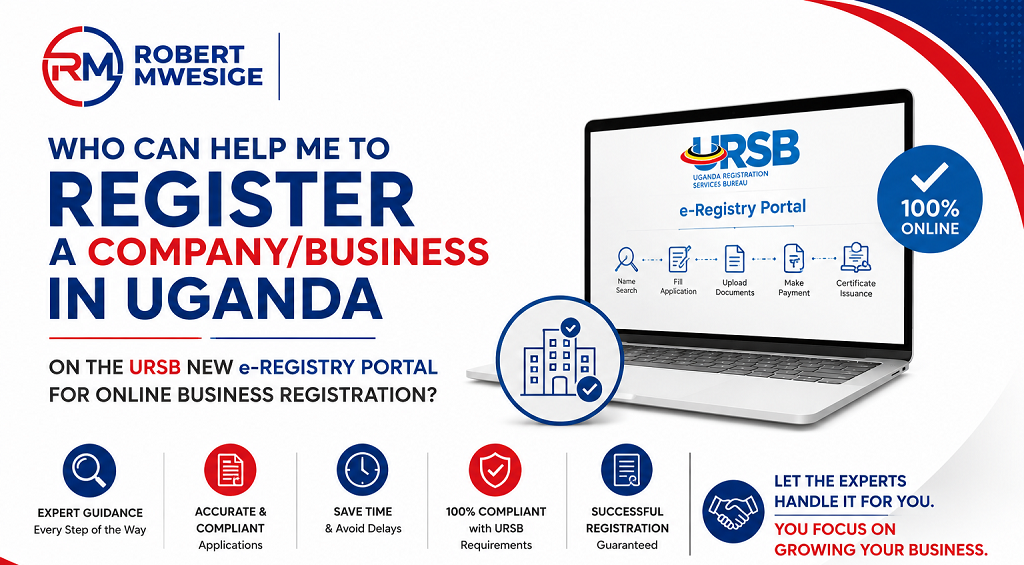
How do I register a company in Uganda online via the URSB New e-Registry Portal?
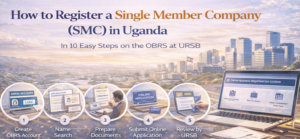
To successfully execute Company Registration in Uganda online, you must log into the official URSB New e-Registry Portal (which is the unified gateway for all corporate registrations). The simplified corporate setup sequence on the e-Registry portal requires completing ten integrated steps:
- Form S18 & Initial Setup: Select your specific entity type (such as a private limited company or a Single Member Company Registration Uganda) and link your approved corporate name.
- Form A1 Submission: Declare your share structure, value per share, and individual subscriber details.
- Form 1 (Compliance and Nominees): Input the Statement of Compliance and designate mandatory Nominee and Alternate Nominee Directors (crucial for single-member setups).
- Memorandum and Articles of Association Uganda: Define core company objectives and adopt internal corporate regulations.
- Form 18 Portal Input: Declare the physical and postal coordinates of the registered office location.
- Form 20 Portal Input: Appoint and record the particulars of all corporate directors, secretaries, and deputies.
- Beneficial Ownership Form URSB (Form 1): Provide transparency declarations regarding ultimate ownership and control mechanics.
- Contact & Tax Registration: Link official communication channels to ensure a URA tax identity is provisioned instantly.
- Document Download & Signature: Preview, download, physically sign, witness, and re-upload the completed forms.
- Payment & Submission: Pay the calculated URSB Registration Fees and stamp duty using an online Payment Reference Number (PRN) before submitting for final registrar review.
Table of Contents
- → The Modern Era of URSB Online Registration: Navigating the URSB New e-Registry Portal
- → Robert Mwesige: Your Strategic Enterprise Growth and Company Incorporation Consultant in Kampala
- → Strategic Value of Corporate Formalization: Why You Must Register a Business in Uganda Legally
- → Core Requirements for Registering a Company in Uganda: Pre-Filing Document Checklist
- → Comprehensive Step-by-Step Guide to Company Registration in Uganda
- → Financial Breakdown: Cost of Registering a Company in Uganda and Fee Structures
- → Choosing the Right Corporate Entity: Aligning Your Ugandan Business Structure for Long-Term Growth
- → Post-Registration Regulatory Compliance: Your Next Steps After Receiving Your Certificate
- → Corporate Bank Account Opening Requirements for Limited Companies in Uganda
- → Deep Dive: High-Growth Sectors and Investment Opportunities in the Ugandan Economy
- → Leveraging Digital Marketing & AI for Post-Incorporation Business Growth
- → Extended Case Study: From a Vision in Mukono to a Thriving Multi-City Enterprise
- → Frequently Asked Questions (FAQs) regarding the URSB New e-Registry Portal
- → Conclusion: Partner with Robert Mwesige to Master Your Company Registration
The Modern Era of URSB Online Registration: Navigating the URSB New e-Registry Portal
The corporate landscape in Uganda has experienced a historic digital upgrade with the launch of the state-of-the-art URSB New e-Registry Portal. This centralized, unified digital platform has completely modernized how entrepreneurs and legal professionals interact with the government registry. Built on a mandate of "One Platform, All Services. One seamless experience," the platform brings business registration, Intellectual Property, Copyright and Neighbouring Rights, Insolvency, Security Interest Registration (SIMPO), and the Non-Individual Register together into a single, highly efficient workspace.
This modernization means that any entrepreneur seeking Business Registration in Uganda or trying to Register a Business in Uganda must set up a secure personal account via the updated URSB Portal Login gateway. The consolidated portal streamlines operations by eliminating physical bureaucracy, significantly reducing the turnaround time required for Company Incorporation in Uganda while introducing stricter compliance verification steps that automated systems cross-check in real time.
For local business owners, regional founders, and international investors alike, mastering this new digital environment is the absolute key to setting up a compliant entity. Navigating these digital forms without errors requires careful attention, as system rejections can lead to delayed rollouts and lost filing fees. This is why many leading founders collaborate with elite Company Registration Agents in Kampala to guide their files smoothly through the registry.
Robert Mwesige: Your Strategic Enterprise Growth and Company Incorporation Consultant in Kampala
When executing your formal URSB Company Registration, having a deeply experienced advisory partner makes all the difference. Robert Mwesige is a highly certified management consulting expert based in Uganda, offering a direct, hassle-free pathway to formalizing local startups, foreign subsidiaries, and large-scale commercial organizations.
Consultant Profile: Robert Mwesige
- Key Credentials: Certified Trainer of the International Labour Organization (ILO) and the Bank of Uganda (BOU), specializing in corporate governance, financial literacy, and startup strategy.
- Academic Foundation: Holds an Executive MBA (EMBA) from the prestigious Quantic School of Business and Technology.
- Digital & AI Specialist: Google-certified digital marketing expert, highly skilled copywriter, and AI systems integration strategist.
- Industry Experience: Over 10 years of experience guiding corporate entities through complex regulatory registries and legal compliance.
Partnering with Robert Mwesige provides your enterprise with a strategic asset that goes far beyond simple document filing. Robert understands how to align your initial incorporation with long-term capital mobilization, solid board governance, digital marketing presence, and strict tax compliance under the Uganda Revenue Authority.
Strategic Value of Corporate Formalization: Why You Must Register a Business in Uganda Legally
Opting to formally Register a Business in Uganda is the ultimate structural foundation for any sustainable commercial enterprise. In professional management consulting, formalization is recognized as the critical turning point where an informal, vulnerable hustle transitions into an independent, scalable corporate asset. Without a recognized legal corporate status, an entrepreneur cannot execute commercial contracts, rent commercial properties securely, or protect their private wealth from sudden business failures.
Formal Company Incorporation in Uganda establishes a completely separate legal identity for your business. This means the company exists as an independent legal "person" under Ugandan law, allowing it to acquire physical assets, register intellectual property, and enter into binding business agreements. More importantly, it provides critical limited liability protection, which legally isolates your personal savings, land, and family homes from any debts, lawsuits, or liquidations the business might face.
Furthermore, formalized companies are positioned to access strategic growth opportunities that are closed to informal traders. International venture capital firms, local commercial banks, and global angel investors do not fund unregistered entities. Similarly, bidding on lucrative private and government tenders requires proof of active incorporation. By completing your URSB Online Registration correctly, you guarantee your business perpetual succession, ensuring that the company survives and continues to grow across generations, long after the original founders or directors step down.
Core Requirements for Registering a Company in Uganda: Pre-Filing Document Checklist on the URSB New e-Registry Portal
Before logging into the URSB Portal Login page, you must carefully organize all the essential Requirements for Registering a Company in Uganda to prevent system errors or administrative rejections.
| Registration Requirement | Description & Compliance Standard | Associated Statutory Document / Portal Action |
|---|---|---|
| Approved Unique Corporate Name | Must be distinct, non-offensive, and free of registered trademarks. | Run a URSB Search Company Name followed by a formal online URSB Name Reservation. |
| Verified Director & Shareholder IDs | National ID cards for Ugandan citizens; high-resolution valid passport scans for foreigners. | Verification via National Identification Number (NIN) or foreign registry databases. |
| Physical & Postal Address Proof | Full details of the physical office location, including plot numbers, streets, and districts. | Declared formally via the digital URSB Form 18 portal submission. |
| Company Constitutional Documents | The foundational regulations governing external goals and internal corporate management. | Customized draft of the Memorandum and Articles of Association Uganda. |
| Ultimate Beneficial Ownership Data | Transparency declaration of individuals holding substantial direct or indirect ownership. | Completed digital Beneficial Ownership Form URSB (Form 1). |
Having these parameters fully structured before starting your digital upload ensures that your application flows smoothly through the registrar's automated verification systems without facing unnecessary queries.
Comprehensive Step-by-Step Guide to Company Registration in Uganda via the URSB New e-Registry Portal
Executing your corporate setup requires following a precise sequence on the modern URSB New e-Registry Portal. This structural roadmap guarantees that your submissions align perfectly with the Companies Act of 2012 and current registrar standards.
The e-Registry portal structure breaks down the traditional, manual registration steps into ten unified digital stages, guiding you seamlessly from name reservation to final submission.
Step 1: Form S18 & Initial Setup
The portal journey begins by opening your profile via the official URSB Portal Login. Once inside, you select the specific company subtype (such as Private Limited Company or Single Member Company Registration Uganda). You then link your pre-approved corporate name, which you secured using the URSB Name Reservation tool after running a thorough URSB Search Company Name query. In this stage, you also input basic company identity variables and physical coordinates.
Step 2: Form A1 - Particulars of Directors, Secretary, and Shares
This stage formalizes the ownership structure of the business. You must declare your nominal share capital, define the total number of authorized shares, and assign their specific value. Click the portal's compute button to automatically calculate and validate the total share capital against your original setup inputs. You also input the legal details and contact channels of all founding subscribers.
Step 3: Form 1 - Statement of Compliance and Nominee Appointments
To proceed with Company Incorporation in Uganda, you must complete the Statement of Compliance declaring that all statutory requirements under the Companies Act have been met. If you are executing a Single Member Company Registration Uganda, the system mandates that you designate a Nominee Director and an Alternate Nominee Director who will legally manage the company should the sole member become incapacitated.
Step 4: Formulating the Share Structure and Drafting the MOA/AOA
During this stage, you define your company's core operational rules and legal purposes. You must formulate and upload your Memorandum and Articles of Association Uganda. The memorandum outlines your primary business sectors, while the articles govern board voting rights, meeting structures, and share transfer rules. You can adopt the standardized, pre-formatted regulations available directly on the portal or upload a customized draft prepared by an experienced consultant.
Step 5: Form 18 - Notice of Situation of Registered Office
The e-Registry requires a formal declaration of your physical office location. You must input specific geographic coordinates, including region, district, sub-county, parish, and village details, alongside your official postal address. This sets the legal physical address where government notices and tax communications will be officially served.
Step 6: Form 20 - Particulars of Directors and Secretary
Here, you formally declare the management structure of your corporate entity. You must input the complete legal names, occupations, residential addresses, and national identification details for all appointed directors and company secretaries. All appointees must confirm their legal consent to manage the company.
Step 7: Beneficial Ownership Form URSB (Form 1)
To satisfy international transparency and anti-money laundering (AML) protocols, you must submit the digital Beneficial Ownership Form URSB. This step identifies any individual holding a direct or indirect stake of 10% or more in the company, ensuring complete ownership transparency on the public registry.
Step 8: Official Company Contact Details and Tax Registration
Under the newly integrated systems of the URSB New e-Registry Portal, this stage ensures that your registration data is securely shared with the Uganda Revenue Authority. Linking your official company email and contact phone numbers triggers the automated creation of your corporate tax account, ensuring that a URA Tax Identification Number (TIN) is issued instantly upon successful company incorporation.
Step 9: Preview, Signatures, and Document Uploads
The portal compiles all submitted data and generates downloadable, official statutory forms. You must download these documents and sign them physically. For legal validity, the subscriber must sign the forms, and a designated witness must sign and indicate their full name, address, and profession. Once physically signed and witnessed, you scan and re-upload the finalized documents back to your portal dashboard.
Step 10: Payment of URSB Registration Fees and Final Submission
The e-Registry calculates your final URSB Registration Fees and stamp duty based on your nominal capital structure. The system then generates an official Payment Reference Number (PRN). You can complete this payment using online options like mobile money or credit cards, or pay physically at any commercial bank branch. Once payment is processed, submit the file on your dashboard to send the complete application to the Registrar of Companies for review and approval.
Financial Breakdown: Cost of Registering a Company in Uganda and Fee Structures
Accurate budgeting is vital for a smooth incorporation process. The total Cost of Registering a Company in Uganda includes statutory government fees, legal stamp duties, local municipal operating licenses, and ongoing corporate compliance costs.
| Fee Category | Estimated Cost (UGX) | Compliance Law Reference |
|---|---|---|
| URSB Name Reservation | UGX 20,000 | URSB Act Cap 210 |
| Minimum Flat Stamp Duty | UGX 50,000 | Stamp Duty Act (Capital up to UGX 5,000,000) |
| Variable Stamp Duty | 0.5% of Share Capital | Stamp Duty Act (Capital over UGX 5,000,000) |
| Administrative Filing Fee | UGX 100,000 | Companies Act 2012 |
| Mandatory Forms (18, 20, 1) | UGX 20,000 per Form | Companies Act 2012 Statutory Filings |
| Kampala KCCA Trading License | UGX 150,000 - 1,000,000+ | Kampala Capital City Authority Act |
The stamp duty calculation is legally determined by your authorized nominal share capital. If your nominal capital is less than or equal to UGX 5,000,000, a flat stamp duty of UGX 50,000 is applied. For capital amounts exceeding UGX 5,000,000, the stamp duty is calculated at a rate of 0.5% of the total declared nominal share capital.
While these government fees are standard, hiring professional Company Registration Agents in Kampala will involve additional consulting fees. These fees vary depending on the complexity of your shareholder agreements, foreign investor requirements, and custom document drafting needs.
Choosing the Right Corporate Entity: Aligning Your Ugandan Business Structure for Long-Term Growth
Selecting the correct legal structure directly impacts your personal liability, taxation, and ability to raise capital. Robert Mwesige guides you in selecting the most strategic corporate vehicle for your venture.
Private Limited Company (Ltd) is the most popular corporate structure in Uganda. It limits shareholder liability to their capital contributions, allows up to 100 shareholders, and is ideal for attracting private investment, venture capital, and commercial bank loans.
Single Member Company Registration Uganda is perfect for solo entrepreneurs. Under the Companies Act 2012, you can pursue a Single Member Company Registration Uganda, allowing a single individual to act as the sole shareholder and director while enjoying full limited liability protection.
To Register Foreign Company in Uganda (Branch / Subsidiary), international firms expanding into Uganda have two primary options. They can incorporate a Local Subsidiary (a separate local entity owned by the parent firm) or register a Foreign Branch Office (a direct extension of the parent company). Registering a branch requires submitting certified parent company charters and appointing a resident local representative authorized to accept legal notices.
Partnerships and Sole Proprietorships are simpler, unincorporated options. While they are quick and cost-effective to set up, they do not provide a separate legal identity. Consequently, the owners face unlimited personal liability for any business debts.
Post-Registration Regulatory Compliance: Your Next Steps After Receiving Your Certificate of Incorporation URSB
Securing your Certificate of Incorporation URSB is a major milestone, but your legal obligations do not stop there. To trade legally, hire staff, and open accounts in Uganda, you must complete several crucial post-registration steps.
The initial post-incorporation step is to Execute Your URA TIN Application for Company Taxes. Every new business must learn How to Get a TIN Number in Uganda immediately after incorporation. You must submit an online URA TIN Application for Company registration through the Uganda Revenue Authority web portal. This tax identity is mandatory for filing corporate income taxes, registering for Value Added Tax (VAT) when your taxable turnover crosses the UGX 150 million threshold, and clearing imported goods.
Next, you must Secure a Local Municipal Trading License before opening your physical doors to clients. You must obtain a valid operating permit from your local government authority. For businesses based in the capital city, you must secure a Trading License Kampala KCCA. If you operate outside Kampala, you must obtain a license from your respective municipal or town council. Operating fees are determined by your specific location grade and industry type.
Thirdly, you must Complete NSSF Registration for Employers Uganda. Under Ugandan labor laws, this registration is mandatory for any business that employs staff. It ensures you comply with national social security requirements, which mandate monthly contributions of 15% of each employee's gross salary (with 5% deducted from the employee's wage, and 10% contributed by the employer).
Corporate Bank Account Opening Requirements for Limited Companies in Uganda
To open a corporate bank account, commercial banks in Uganda require a certified set of corporate documents to satisfy strict Know Your Customer (KYC) regulations. The necessary documentation profile includes a copy of your Certificate of Incorporation URSB certified by the Registrar of Companies, a certified copy of your custom-drafted Memorandum and Articles of Association Uganda, and certified copies of your statutory portal filings, specifically URSB Form 18 (physical address) and URSB Form 20 (directors and secretary).
Additionally, banks demand a certified URSB Search Company Name report from the e-Registry portal confirming the company is active (which requires a search fee of UGX 50,000), a registered copy of your Beneficial Ownership Form URSB (Form 1), your official company Tax Identification Number (TIN) provided by the URA, a formally signed board resolution authorizing the account opening using approved URSB Board Resolution Templates, valid national ID cards or passports for all directors and account signatories, and proof of your physical business location, such as a tenancy agreement or utility bill.
Deep Dive: High-Growth Sectors and Investment Opportunities in the Ugandan Economy
Uganda boasts one of the youngest, most dynamic populations in Africa. A rapidly expanding economy makes this the perfect time to register your company and tap into high-growth sectors.
In Agribusiness & Value Addition, commercial farming, cold storage, and agro-processing (processing coffee, tea, cocoa, and dairy) dominate. Registered agribusinesses can access the Bank of Uganda’s Agricultural Credit Facility (ACF) for low-interest development financing.
For Tourism & Hospitality, opportunities center on eco-tourism lodges, tour operators, and hospitality brands. Registered tourism companies enjoy direct marketing support from the Uganda Tourism Board and fast-tracked licensing.
The Information & Communication Technology (ICT) sector features growing demand for software development, fintech solutions, digital marketplaces, and AI integrations. Legally incorporated tech startups can pitch to global venture capitalists and qualify for government grants.
In Manufacturing & Light Industry, producing textiles, construction materials, pharmaceuticals, and food products yields strategic advantages. Operating a registered manufacturing plant in a designated industrial park yields substantial tax incentives under national investment frameworks.
Finally, the Renewable Energy & Environmental Services sector focuses on solar installations, waste-to-energy projects, and carbon offset initiatives. Registered companies in this sector can participate in carbon trading and green financing.
Leveraging Digital Marketing & AI for Post-Incorporation Business Growth
Incorporation is just the first step. To thrive in a competitive market, your business must establish a powerful digital presence. As a Google-certified digital marketing expert and a prolific copywriter, Robert Mwesige helps you leverage Search Engine Optimization (SEO), programmatic advertising, and content marketing to attract clients across East Africa.
He specializes in Targeted SEO, crafting high-converting websites optimized for high-intent keywords to capture organic traffic. He also delivers AI Implementation services, automating lead generation, integrating AI chatbots to handle 24/7 client queries, and configuring CRM tools to manage sales pipelines. Finally, Robert supports Branding & Identity, designing professional logos, corporate profiles, and search-optimized blogs that position your brand as an industry authority.
Extended Case Study: From a Vision in Mukono to a Thriving Multi-City Enterprise using the URSB New e-Registry Portal
Background and Launch Challenges
Sarah, an ambitious entrepreneur based in Mukono, wanted to launch an eco-friendly fashion brand using locally sourced organic cotton. Her vision was to employ local youth and establish an ethical, sustainable manufacturing business. Sarah originally tried to navigate the registration process on her own. Unfortunately, her applications were repeatedly queried on the portal due to inconsistent naming conventions and incomplete draft articles. She also struggled to file her Beneficial Ownership forms and set up her URA tax profile, which delayed her launch by four months and caused her to miss a major seed funding deadline.
Professional Intervention and Resolution
Sarah reached out to Robert Mwesige for professional assistance. Robert analyzed her business model and recommended a Private Limited Company structure, drafting a custom Memorandum and Articles of Association Uganda that explicitly protected her brand's sustainability goals. Robert successfully managed the entire application process on the URSB New e-Registry Portal, correctly filing her URSB Name Reservation, Beneficial Ownership Form URSB (Form 1), URSB Form 18, and URSB Form 20. He then secured her company URA TIN, guided her through NSSF Registration for Employers Uganda, and acquired her local municipal trading license.
Commercial Growth and Business Outcomes
Within 5 working days, Sarah received her official Certificate of Incorporation URSB. Robert then helped her build an SEO-optimized e-commerce platform and trained her on digital marketing strategies. Today, Sarah's clothing brand employs over 15 tailors in Mukono, processes orders from Entebbe, Jinja, and Kampala, and recently secured a regional export contract—all because her business was structured professionally and legally from day one.
Frequently Asked Questions (FAQs) regarding the URSB New e-Registry Portal
How long does it take to register a company in Uganda?
With Robert Mwesige guiding your application, standard URSB Company Registration takes between 3 to 5 business days once all forms are correctly filled, signed, and uploaded to the modern digital platform.
Is a lawyer mandatory for company registration?
No, a lawyer is not mandatory. Working with experienced Company Registration Agents in Kampala like Robert Mwesige ensures your document preparation, MOA drafting, and portal submissions are executed without paying high legal retainer fees. For complex multi-tier shareholder agreements, Robert collaborates with trusted legal partners to keep your entity secure.
What are the main requirements for registering a foreign company?
To Register Foreign Company in Uganda as a branch, you will need certified copies of the parent company's charter, its certificate of incorporation, a list of directors, and a registered local representative authorized to accept legal notices.
How do I open a corporate bank account in Uganda?
You will need a certified copy of your Certificate of Incorporation, Form 18, Form 20, the Beneficial Ownership Form, your URA TIN, and a formally signed board resolution. Robert provides pre-formatted URSB Board Resolution Templates to speed up this process with your bank.
What is the difference between a sole proprietorship and a private limited company?
A sole proprietorship is owned and managed by one individual. The owner has unlimited liability, meaning personal assets can be used to settle business debts. A private limited company, on the other hand, is a separate legal identity. The liability of shareholders is limited to the shares they hold.
What happens if I want to change my company name or structure later?
You can change your company name by passing a special resolution and submitting an application to URSB with the proposed name. Similarly, you can convert from a private limited company to a public limited company or vice versa by following the procedures in the Companies Act. Robert guides you through drafting resolutions, amending the Memorandum and Articles of Association, and completing the necessary forms.
How do I close or wind up my company?
Closing a company involves either voluntary or compulsory winding‑up. Voluntary winding‑up is initiated by the shareholders when the company has fulfilled its purpose or becomes insolvent. The process includes passing a resolution, notifying creditors, and appointing a liquidator. Robert explains the legal implications, prepares the necessary documents, and coordinates with URSB and the Official Receiver to ensure a lawful and orderly closure.
Conclusion: Partner with Robert Mwesige to Master Your Company Registration in Uganda via the URSB New e-Registry Portal
Successfully executing your formal Company Registration in Uganda is the ultimate structural step toward building a credible, scalable, and highly profitable enterprise. Navigating the modern compliance requirements of the unified URSB New e-Registry Portal remains a sophisticated task that demands complete accuracy. From performing an initial URSB Search Company Name and securing your official URSB Name Reservation to drafting a robust Memorandum and Articles of Association Uganda, every compliance step is critical to your ultimate commercial success.
Failing to properly complete required statutory portal forms such as the digital Beneficial Ownership Form URSB (Form 1), URSB Form 18, and URSB Form 20 can result in immediate system rejections, delayed launches, and lost URSB Registration Fees. To protect your startup capital and launch with complete peace of mind, partnering with top-tier Company Registration Agents in Kampala is a highly strategic choice that guarantees professional execution.
Robert Mwesige provides a comprehensive, stress-free path to successful URSB Company Registration and complete business formalization. Beyond obtaining your Certificate of Incorporation URSB, Robert assists you with your post-incorporation setup, including your URA TIN Application for Company taxes, learning How to Get a TIN Number in Uganda, securing your Trading License Kampala KCCA, completing your NSSF Registration for Employers Uganda, and preparing compliant URSB Board Resolution Templates for your banking needs. Secure your brand, protect your personal wealth with a robust Single Member Company Registration Uganda, or expand your global reach by choosing to Register Foreign Company in Uganda with professional confidence. Reach out to Robert Mwesige today to navigate the URSB New e-Registry Portal and position your venture for long-term commercial success in East Africa.