Government AI strategy · Digital public services · Uganda
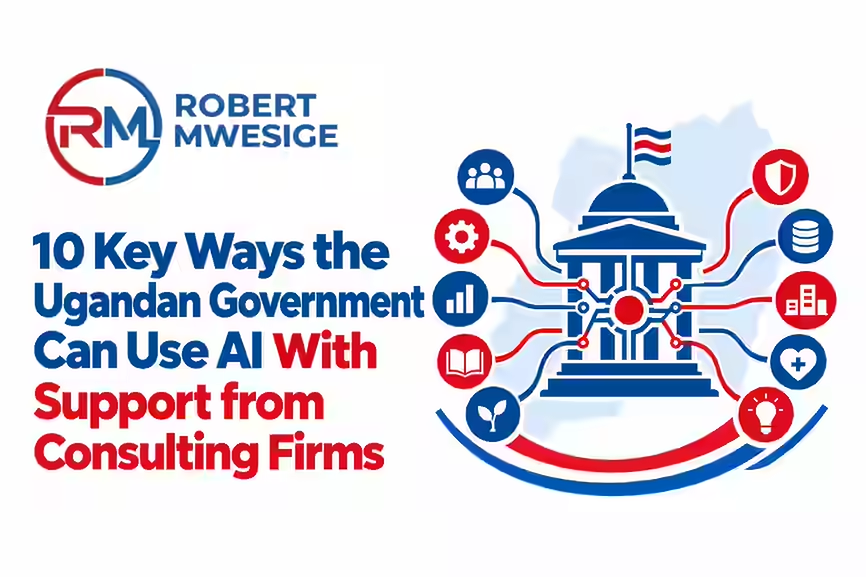
10 Key Ways the Ugandan Government Can Use AI With Support from Consulting Firms
A practical, internationally informed framework for Uganda’s ministries, departments, agencies and local governments to adopt artificial intelligence responsibly.
How can the Ugandan Government use artificial intelligence? Uganda can apply AI to citizen services, records management, revenue compliance, procurement, healthcare, education, agriculture, infrastructure, civil-service productivity and evidence-based policymaking. Successful deployment starts with appropriate governance, reliable data, skilled staff, risk assessment, human oversight and measurable pilot projects.
Uganda does not need to begin its artificial intelligence journey by buying the most expensive platform. The better starting point is to identify public-service problems, assess the quality of government data, select accountable institutions and test AI tools against clear performance measures. The public should experience the benefit through faster responses, more accurate information, accessible services and stronger accountability, not merely through a new technology announcement.
Artificial intelligence in government refers to the responsible use of systems that can analyse information, recognise patterns, generate content or support decisions in public administration. This includes machine learning, document intelligence, language technologies, forecasting and carefully controlled generative AI. It does not mean transferring public authority to software. Civil servants and authorised officials remain answerable for decisions affecting citizens.
Uganda already has a policy foundation for this work. The Ministry of ICT and National Guidance's Digital Transformation Roadmap 2023/24–2027/28 addresses connectivity, digital services, cybersecurity and privacy, digital skills, and innovation. NITA-U's Strategic Plan FY2025/26–FY2029/30 provides a further institutional reference point. AI initiatives should strengthen those programmes and existing public-sector systems, rather than create competing technology silos.
Robert Mwesige supports public institutions with structured AI opportunity research, international benchmarking, change-management advice, executive training, use-case prioritisation, implementation roadmaps and performance measurement. His contribution can help ministries, departments, agencies and local governments make informed choices, engage competent technical suppliers and retain ownership of their public obligations.
Practical, sector-specific public-service opportunities.
Human accountability, data protection and fair outcomes.
A staged example, not a claim of guaranteed rollout time.
Before Uganda adopts AI: what leading governments get right
Before automating a service, each institution should establish the legal mandate for processing the relevant data, map existing systems, appoint an accountable business owner and assess the likely effect on citizens. A use case with unclear legal authority or an unacceptable risk profile should not move into deployment merely because its software demo is impressive.
The most transferable lesson from the United Nations, OECD, NIST, the UK and US government is institutional: clear responsibility, a managed inventory of AI systems, proportional controls, documented testing, transparency and ongoing monitoring. The EU AI Act adds a useful example of risk categorisation. Its rules apply in the EU according to their legal scope; they should not be described as Ugandan law.
Another critical distinction is between general digital transformation and AI. Reliable connectivity, identity management, interoperability, secure hosting, accessible public websites, records controls and staff skills must often come first. Uganda's existing digital transformation agenda offers a structure for sequencing these investments. An agency should also consider whether a conventional rules engine or service redesign delivers the same result with less cost and risk.
Every proposed AI use case should pass six questions: What public problem does it address? Which official owns the decision? What data are needed and who may lawfully access them? How will errors and bias be detected? Can a person challenge an adverse outcome? What measurable improvement justifies the full lifecycle cost? These questions help separate scalable public value from technology enthusiasm.
International reference points include the UN AI governance report, OECD AI Principles, NIST risk-management framework and UK Government AI Playbook.
Ten practical AI opportunities across government
The examples below are proposed applications for assessment, not claims that the named Ugandan institutions have deployed these exact systems. Each one requires sector-specific legal review and evidence of value before scaling.
Citizen services, contact centres and multilingual information
Practical opportunity: Citizens often need to know which office handles a service, which documents to bring, how to track a request and when an administrative decision may be expected.
Citizens often need to know which office handles a service, which documents to bring, how to track a request and when an administrative decision may be expected. A government-approved AI assistant could explain verified procedures, search official policy documents and direct people to the right service channel. It could operate on a ministry website, an approved mobile service or a contact-centre knowledge base. The best version gives evidence and source links, rather than producing confident but unsupported answers.
A sensible initial pilot would cover a narrow, frequently asked service such as licence requirements or application status guidance. The service should provide English and, after testing, selected Ugandan languages. Accessibility must include low-bandwidth pages, assisted access and a route to a human officer. A chatbot cannot lawfully create a new fee, alter eligibility or refuse a benefit. Where an answer depends on individual confidential records, authenticated systems and access controls are essential.
The UK's AI Playbook and public-service exemplars offer practical lessons in testing useful government applications while retaining human review. Uganda can adapt the approach to citizen service centres, local governments and ministries without copying another country's legal arrangements. The value is a clear service, maintained source material, monitored errors and accountable staff.
Consulting support would include mapping common enquiries, validating approved reference content, documenting privacy and language needs, designing escalation workflows and comparing service performance before and after the pilot. Track first-contact resolution, incorrect-answer rates, abandonment, language coverage, accessibility complaints and the percentage of escalations resolved by a real officer. Publish a clear notice whenever citizens are interacting with an AI system.
Implementation principle: Start with one measurable workflow, establish a baseline and retain authorised human oversight throughout the pilot.
Public administration, records and document processing
Practical opportunity: Government offices handle correspondence, cabinet submissions, regulatory files, procurement attachments, reports and historic records.
Government offices handle correspondence, cabinet submissions, regulatory files, procurement attachments, reports and historic records. AI-assisted optical character recognition, document classification and retrieval can reduce the time needed to locate information or prepare first drafts. A searchable, well-governed repository can help a designated officer find relevant records without repeating manual searches across multiple systems.
The essential sequence is digitisation, records classification, information security and only then automation. Documents containing personal data, national security information, legal privilege or procurement-sensitive material cannot be placed into unrestricted consumer tools. Each document type requires an access rule and retention schedule. AI-generated summaries must remain traceable to original records, and official approvals must continue through authorised workflow systems.
For example, a ministry might pilot automated classification of non-sensitive incoming letters. An evaluator would measure correct category assignment, missing attachments, turnaround time and false matches. A second-stage project could support internal searching of approved circulars, procedures and administrative manuals, with citations shown beside retrieved answers. A failure case should be logged and corrected, not silently ignored.
Robert Mwesige can support workflow research, staff consultations, business requirements, procurement specifications, change-management plans and independent acceptance criteria. A good consultant also asks whether simpler electronic document management, better templates or integration of existing systems might solve the problem more cheaply. The objective is consistent administration, not AI for its own sake.
Implementation principle: Start with one measurable workflow, establish a baseline and retain authorised human oversight throughout the pilot.
Teams that need foundational document collaboration skills can build them through the Google Workspace Training Course in Uganda can help staff manage approved files and work collaboratively before more complex automation is introduced.
Revenue administration, compliance and fraud-risk detection
Practical opportunity: Tax, customs, grants and public financial-management functions involve high transaction volumes and complex patterns.
Tax, customs, grants and public financial-management functions involve high transaction volumes and complex patterns. Predictive analytics may help authorised agencies prioritise audits, detect unusual transactions, identify duplicate claims and recognise compliance anomalies. Machine learning can produce useful risk signals where lawful, accurate and sufficiently representative data are available. However, a statistical signal is not proof of fraud.
Revenue and anti-fraud applications demand stronger safeguards than an internal drafting tool. Agencies should analyse error rates across affected groups, keep evidentiary records, protect taxpayer confidentiality and make consequential decisions reviewable by authorised officials. Models trained on historical enforcement patterns may reproduce past weaknesses or unfairly concentrate scrutiny on particular categories. A proportionate investigation policy must therefore sit above the algorithm.
Uganda could begin with a controlled study using de-identified historical datasets and a defined compliance question. Compare the proposed model against existing rules-based screening, calculate false positives and false negatives, and document whether staff time is genuinely saved. A predictive model should be suspended when data drift, unexplained results or unfair effects exceed agreed thresholds. Procurement should require documentation, auditability and testing access.
Advisory support can map business risks, define independent model-evaluation criteria, design management dashboards and establish value-for-money measures. It should involve the responsible revenue authority, legal teams, auditors and information-security specialists from the beginning. The goal is fairer and better-targeted administration with documented oversight, not automated accusations against citizens or businesses.
Implementation principle: Start with one measurable workflow, establish a baseline and retain authorised human oversight throughout the pilot.
A structured risk assessment, supported by a Risk Management Consultant in Uganda can help define controls, escalation rules and assurance criteria before a detection model is commissioned.
Public procurement, contract monitoring and value for money
Practical opportunity: Public procurement is an opportunity to improve transparency and detect inefficiencies.
Public procurement is an opportunity to improve transparency and detect inefficiencies. AI-supported analytics can examine procurement plans, contract registers, expenditure trends and supplier performance to flag unusual price movements, delivery delays, contract variations or repeated purchasing patterns. Language models can help authorised teams compare tender documents against a checklist, while procurement officials retain responsibility for interpretation and award decisions.
The first requirement is reliable and accessible procurement data. A well-structured contract register, standard item descriptions and consistent supplier identifiers often produce more value than a sophisticated algorithm built on inconsistent records. Procurement information is also commercially sensitive. AI vendors must not use confidential bids to train public or shared models without lawful authority, and tools must not introduce undisclosed scoring factors.
An initial pilot might analyse completed contracts in one spending category, comparing unit prices and delivery performance after adjusting for specification, location, volume, taxes and market conditions. Anomalies become questions for review, not automatic evidence of corruption. For active tenders, evaluation methods, procurement legislation, conflicts-of-interest rules and documented approvals remain paramount.
Robert Mwesige can assist in process mapping, requirements development, procurement risk research, supplier-market analysis, performance scorecards and structured capacity development. The US OMB's federal AI acquisition guidance offers a useful reference for evaluating vendor claims, competition, data rights and lifecycle obligations, although Uganda must apply its own procurement framework. Measure verified cost avoidance, contract-compliance rates, time-to-review and the number of findings validated by humans.
Implementation principle: Start with one measurable workflow, establish a baseline and retain authorised human oversight throughout the pilot.
For teams still standardising procurement data, Advanced Microsoft Excel Training in Uganda may strengthen the accuracy and auditability of early-stage spending analyses.
Health systems, clinical administration and public-health planning
Practical opportunity: Public health agencies and health facilities may benefit from AI-assisted forecasting, logistics, appointment coordination and administrative work.
Public health agencies and health facilities may benefit from AI-assisted forecasting, logistics, appointment coordination and administrative work. Suitable use cases include predicting medicine stock requirements from reliable consumption data, improving disease-surveillance signal review, organising non-clinical case documents and identifying service bottlenecks. These are operational supports rather than replacements for qualified health professionals.
Clinical diagnosis, treatment recommendations, triage and the processing of sensitive health records require especially stringent assessment. Any deployment must follow applicable Ugandan health regulations, clinical protocols, data-protection rules and medical-device requirements where relevant. Public officials should insist on local validation, demographic and geographic performance tests, professional review and a process for responding to adverse outcomes.
A cautious pilot could focus on forecasting the stock of selected essential medicines at consenting facilities. Start with data completeness, supply-chain delays, stockouts, forecasting error and staff workload. Test the system against conventional forecasting methods for an agreed period before considering scale-up. Rural facilities, intermittent connectivity and incomplete records should be explicitly represented in the evaluation.
Independent consulting can organise the readiness study, interview clinicians and logistics teams, define indicators, assess procurement alternatives and write a scale-up recommendation. The World Bank's 2026 World Development Report notes that AI can strengthen public services but that evidence, skills and connectivity constraints matter. For Uganda, success should mean fewer stockouts, shorter administrative queues and safer workflows, not a headline about AI-enabled hospitals.
Implementation principle: Start with one measurable workflow, establish a baseline and retain authorised human oversight throughout the pilot.
Education, teacher support and skills development
Practical opportunity: Education ministries, universities, schools and training institutions can use AI to prepare learning resources, identify curriculum gaps, support administrative reporting and help educators differentiate instruction.
Education ministries, universities, schools and training institutions can use AI to prepare learning resources, identify curriculum gaps, support administrative reporting and help educators differentiate instruction. Properly supervised tools could help teachers draft lesson plans, generate practice exercises or translate accessible explanations. Institutions should assess the reliability and cultural relevance of content before classroom use.
Educational AI requires safeguards for minors, student privacy, academic integrity and equal access. Automated systems should not make final high-stakes decisions about admissions, discipline or examination outcomes without lawful authority and meaningful human processes. Language accessibility, disability inclusion and differences in connectivity between schools must guide design. An intervention that works only in well-resourced urban schools can widen rather than close educational gaps.
A useful first pilot might provide vetted lesson-planning assistance to a small group of teachers, with a comparison group and an independent review of content accuracy, preparation time and teacher satisfaction. Students' personal records need not be uploaded to run such a pilot. Another possible application is summarising anonymised school-level administrative reports, subject to data-quality checks.
Robert Mwesige can help education institutions commission needs assessments, prepare training programmes, select measurable use cases and strengthen leadership capabilities. The approach should combine AI literacy with broader digital skills, pedagogy and change management. Evaluate gains through teaching quality and learning-support measures rather than counting how many staff accounts were issued.
Implementation principle: Start with one measurable workflow, establish a baseline and retain authorised human oversight throughout the pilot.
Role-specific staff development, including AI Training in Uganda should be adapted to educators’ specific responsibilities and safeguarding requirements.
Agriculture, extension services and climate resilience
Practical opportunity: Agriculture and environment institutions can use AI-supported models to interpret weather information, crop observations, soil data, satellite imagery and market trends.
Agriculture and environment institutions can use AI-supported models to interpret weather information, crop observations, soil data, satellite imagery and market trends. Properly validated tools could assist extension officers with advisory material, highlight emerging pest risks or improve planning for climate-related disruptions. Forecasting information can help target field visits and guide scarce resources toward communities most in need.
Advice must be grounded in local conditions. Agricultural recommendations can be unsafe or economically damaging when a model ignores the crop variety, season, rainfall pattern or farmer's actual circumstances. Forecast uncertainty should be explicit. Agencies should not represent probabilistic estimates as guaranteed harvest outcomes, and human extension professionals should review guidance before field deployment.
A pilot could combine approved meteorological data with district-level historical observations to help plan extension outreach. Test predictions against observed conditions, record missed events and assess whether farmers can receive advice through familiar channels. Farmers who lack smartphones should still be served through radio, cooperatives, extension workers and other accessible mechanisms. Establish ownership and licensing rules for datasets supplied by farmers or partner organisations.
Consulting support could involve stakeholder mapping, technology and data-readiness assessments, evaluation design and coordination between agriculture, water, environment and local government actors. The objective is better-informed decisions and stronger resilience. A smaller, trusted decision-support service may outperform an ambitious national platform that farmers cannot access or verify.
Implementation principle: Start with one measurable workflow, establish a baseline and retain authorised human oversight throughout the pilot.
Infrastructure, transport and urban planning
Practical opportunity: Road networks, utilities, municipal assets and construction programmes generate data that can improve planning and maintenance.
Road networks, utilities, municipal assets and construction programmes generate data that can improve planning and maintenance. AI tools may help analyse road-condition images, predict equipment failures, review maintenance reports and prioritise infrastructure inspections. Geospatial analysis can support urban planning and disaster preparedness when authoritative data and trained specialists are available.
Such systems must be introduced as decision-support tools. A detected defect requires technical verification, and a predicted maintenance priority must be assessed against engineering standards, public safety and budget rules. Surveillance-based systems raise additional concerns about privacy, public consultation and proportionate use. Critical infrastructure information should be subject to enhanced cybersecurity and vendor-access controls.
A local-government pilot could classify road-maintenance complaints and combine them with validated inspection records. A dashboard might show response times, recurring defects, budget commitments and completion status. The project should compare results with existing inspection methods and account for areas where complaints are underreported because connectivity is poor. No community should be excluded merely because fewer digital reports originate there.
Robert Mwesige can facilitate service-design workshops, define reporting standards, develop performance-management approaches and assess delivery risks with engineering and ICT specialists. A clear procurement scope should distinguish data collection, engineering validation, analytics and decision authority. Measure maintenance response time, validated defect-detection accuracy and the percentage of completed work independently verified.
Implementation principle: Start with one measurable workflow, establish a baseline and retain authorised human oversight throughout the pilot.
Human resources, workforce productivity and civil-service learning
Practical opportunity: Public servants require practical, role-specific skills if AI adoption is to improve government performance.
Public servants require practical, role-specific skills if AI adoption is to improve government performance. Approved AI tools can assist with meeting summaries, searching non-sensitive policies, preparing draft reports and organising routine tasks. Analytics may support workforce planning, training-needs assessment and workforce deployment analysis. Used appropriately, these tools allow officers to devote more attention to judgement, service quality and difficult citizen cases.
Employment applications carry important fairness risks. Algorithms used in recruitment, promotion, performance review or disciplinary processes can amplify bias or hide the reasons behind decisions. They therefore require legal review, transparent criteria, human accountability and appropriate appeal arrangements. The US Office of Personnel Management issued guidance on AI in federal hiring in August 2026, illustrating why government HR adoption should be governed by explicit rules rather than casual experimentation.
A prudent first step is an AI literacy programme that explains permitted tools, privacy, security, hallucinations, verification and recordkeeping. Follow this with small productivity pilots in low-risk administrative functions, and use performance indicators rather than anecdotes. Staff should understand when to disclose AI assistance and when a document requires independent checking.
Robert Mwesige can support institutional capability reviews, executive briefings, leadership workshops, job redesign and training evaluation. His related programmes in AI training, digital transformation, executive leadership and performance management can help institutions build enduring capability. Training must be paired with updated procedures and access to approved tools; attendance alone is not evidence of improved government productivity.
Implementation principle: Start with one measurable workflow, establish a baseline and retain authorised human oversight throughout the pilot.
Senior public-sector leaders can consider the Executive Leadership Training Skills Program in the Age of AI in Uganda as one route to discussing adoption, organisational accountability and change management.
Evidence-based policymaking, monitoring and development planning
Practical opportunity: Ministries and planning institutions can use AI to search research literature, classify public submissions, analyse survey data and support forecasting scenarios.
Ministries and planning institutions can use AI to search research literature, classify public submissions, analyse survey data and support forecasting scenarios. Natural-language tools may help policy teams find evidence across long documents, while statistical models can explore carefully framed questions about service demand or programme performance. These capabilities can speed up analysis but do not convert weak data into reliable conclusions.
A policy brief generated by AI must still undergo source verification, expert interpretation and consultation. Models can invent references, overstate causal relationships or confuse correlation with evidence of impact. Public consultations must also account for people who do not participate online. Policy choices involve legal mandates, resources and competing public values that cannot be delegated to an opaque system.
A strong pilot might organise a repository of approved evaluations and help analysts locate studies by question, sector, geographic area and quality. Require every AI-assisted synthesis to link back to documents that reviewers can inspect. A separate initiative could test forecasting in an established statistical workflow, documenting data lineage, assumptions and sensitivity analysis. Research integrity and reproducibility should be part of acceptance testing.
Robert Mwesige can contribute research design, institutional benchmarking, monitoring and evaluation frameworks, stakeholder engagement and implementation scorecards. The UN's guidance on inclusive AI governance and the OECD AI Principles reinforce the need for transparency, accountability and human-centred outcomes. An effective national programme should evaluate whether decisions become better supported by evidence, not simply whether more charts and reports are produced.
Implementation principle: Start with one measurable workflow, establish a baseline and retain authorised human oversight throughout the pilot.
Linking pilot outcomes to independent evidence and Monitoring and Evaluation Services in Uganda can help agencies establish credible baselines, indicators and evaluation methods.
National AI readiness framework for ministries, departments and agencies
An AI readiness assessment should cover leadership sponsorship, legal and ethical safeguards, public-value prioritisation, data quality, cybersecurity, digital infrastructure, workforce capability, vendor management and evaluation. It should also identify existing investments to reuse. Institutions that cannot explain their data flows or access controls need a foundation project before deploying powerful generative AI.
A practical governance arrangement includes an accountable senior sponsor, business process owners, ICT and cybersecurity staff, a data protection function, procurement specialists, legal advisers and independent audit or evaluation personnel. For high-impact projects, meaningful consultation with affected groups is essential. Each live system should have a named owner, an approved purpose, documented limitations and a tested incident-response procedure.
The AI inventory should state the vendor and model, data categories, risk tier, intended users, beneficiaries, procurement terms, deployment environment, human review points, testing evidence and review dates. Agencies should distinguish publicly published information from internal records and restricted data. In cross-agency projects, data-sharing arrangements and interoperable technical standards must be established before integration.
Governance is not a single policy document. It is an ongoing cycle of defining accountability, measuring impacts, managing risks and deciding whether to improve, suspend or retire systems. Building a public-sector community of practice can help agencies reuse lessons, common procurement clauses, incident reports and training materials instead of repeating mistakes.
For officials responsible for institutional oversight, Corporate Governance and Board Leadership Training in Uganda may support the governance skills needed to scrutinise proposed AI programmes.
| Readiness dimension | Questions to answer | Expected output |
|---|---|---|
| Governance | Who owns the AI system and decisions? | AI register and accountability matrix |
| Data and privacy | Can information be used legally and securely? | Data mapping and privacy assessment |
| Technical readiness | Can infrastructure support dependable operations? | Integration and security assessment |
| Capability | Do officials understand use and limitations? | Role-based learning plan |
| Public value | What improves for citizens and taxpayers? | Baseline and KPI scorecard |
| Procurement | Can the agency exit or change vendors? | Lifecycle contract and exit requirements |
A practical 90-day AI pilot roadmap for government institutions
Days 1–15: obtain executive sponsorship and appoint an interdepartmental working group. Map the service problem, affected users, statutory mandate, current process, available data and existing technology. Screen proposals for legal, privacy, information-security and human-rights risks. Avoid collecting sensitive citizen data during initial demonstrations.
Days 16–30: prepare a longlist of use cases and score them for public value, feasibility, costs, data readiness, potential harms and ease of monitoring. Select a low- or moderate-risk pilot. Write a business case with alternative options, including doing nothing, simpler process redesign and conventional automation. Identify procurement and technical controls before choosing a vendor.
Days 31–60: configure or commission the limited pilot, establish security and access rules, train authorised staff and develop a test set using lawful representative data. Conduct user testing, record known limitations, and verify accuracy against an approved baseline. Where the tool generates text, assess factual grounding and hallucination rates; where it predicts outcomes, assess error distributions and model drift.
Days 61–90: operate a controlled trial with human review, test incident escalation and compare results with baseline service performance. Collect structured feedback from citizens and front-line officers. Prepare a decision report recommending scale-up, redesign, further trials or retirement. The 90-day timetable is an illustrative planning framework: procurement, security, data permissions and statutory approvals may require significantly longer.
For a national programme, a second phase should establish reusable policies, technical standards, shared evaluation methods and capacity-building materials. Cross-government coordination is beneficial, but accountability should remain clearly assigned to each responsible institution. Record both successes and failures so public money does not fund repeated experiments with the same preventable weaknesses.
For appropriate non-sensitive operational data, dashboard skills developed through Microsoft Power BI Training in Uganda can support clear reporting of agreed pilot metrics without placing sensitive information in unapproved platforms.
| Phase | Primary work | Decision gate |
|---|---|---|
| Days 1–15 | Problem and readiness review | Authority and risk screening |
| Days 16–30 | Use-case selection and business case | Pilot approval |
| Days 31–60 | Configuration, validation and training | Safety and quality acceptance |
| Days 61–90 | Controlled trial and evaluation | Scale, revise or stop |
Specialist advisory and implementation preparation
How Robert Mwesige can support government AI and digital transformation
Government AI transformation is not only a software-engineering assignment. Institutions also need well-founded research, organisational analysis, workforce preparation, coherent procurement requirements and independent performance evaluation. A multidisciplinary consulting engagement can help government buyers ask the right questions before committing budgets and can coordinate specialist technical, legal and sector expertise when required.
Robert Mwesige is positioned to support the advisory and institutional-development components of this work. Potential services include international benchmarking of government AI frameworks, strategic planning workshops, institutional digital maturity studies, business-process analysis, pilot prioritisation, research and stakeholder consultation, terms of reference, change management, leadership training and monitoring and evaluation. Where technical implementation or specialist security assurance is needed, the institution should engage appropriately qualified professionals under its procurement and governance arrangements.
An engagement might begin with a short diagnostic across selected agencies, followed by a prioritised opportunity portfolio and a policy-aligned implementation roadmap. Each recommendation should include an indicative business case, data dependencies, risk classification, procurement considerations and a measurable success criterion. A subsequent phase may support project management, staff capacity development and independent post-pilot evaluation.
This approach gives public executives a defensible decision process and helps procurement teams distinguish genuine institutional needs from promotional vendor claims. It also recognises that a municipality, a national ministry, a regulator and a public university have different mandates, capacities and legal risks. No single AI product should be presumed suitable for all of them.
Capacity development is especially important. Leadership workshops can explain the responsibilities of accounting officers and boards; practitioner sessions can cover responsible prompting, verification, documentation, analytics and change management. A training-needs assessment should identify priority roles and assess skills gained in actual work, not only participant satisfaction.
For institutions ready to explore opportunities, the first conversation can focus on the service problem, the agency's current digital maturity and the information needed to commission a credible readiness study. The desired output is a practical path from opportunity identification to accountable, measurable public-service improvement.
AI opportunity and readiness assessment
Institutional diagnostics, evidence gathering, stakeholder interviews, use-case portfolio and prioritisation.
Discuss readiness assessmentStrategy, governance and pilot design
Policies, risk controls, business case, terms of reference, KPIs and implementation roadmap.
Request advisory supportLeadership training and change management
AI literacy, public-sector leadership briefings, skills development and adoption evaluation.
Institutions comparing advisory approaches can also review the landscape of AI Consulting Companies in Uganda while retaining competitive procurement and independent technical due diligence.
Explore AI trainingFrequently asked questions about AI in Ugandan government
What is the best first AI project for a Ugandan ministry?
Select one high-volume, well-documented and comparatively low-risk administrative workflow with reliable data and an accountable owner. Examples include a verified information assistant or internal classification of non-sensitive correspondence. Validate the baseline and safeguards before any rollout.
Does Uganda need a new AI law before agencies can pilot AI?
A new dedicated AI statute is not necessarily a prerequisite for every lawful pilot. Each use must already comply with applicable Ugandan laws, public-sector mandates, data protection, security, procurement and administrative requirements. High-risk applications may need additional policy or regulatory action.
Can AI make government decisions without a human officer?
The appropriate answer depends on the legal power and risk involved. AI should generally support rather than replace accountable public decision-makers, especially where rights, eligibility, enforcement, health, employment or public money are at stake. Document human review, reasons and routes for correction or appeal.
How should Uganda protect government data when using generative AI?
Classify data, approve tools, restrict access, minimise inputs, define retention and training restrictions, assess vendor security and use controlled integrations. Do not upload confidential public records or personal information to unapproved public services.
Which global standards should ministries consult?
Useful reference materials include the UN AI governance report, OECD AI Principles, UNESCO ethical guidance, NIST AI Risk Management Framework, UK AI Playbook, US OMB agency policies and the EU risk-based AI framework. Adapt them to Uganda rather than copying foreign law.
How much does a government AI pilot cost?
There is no universal price. Costs depend on data preparation, platform licensing, integration, cybersecurity, testing, training, evaluation, hosting and ongoing support. Compare full lifecycle costs and less complex alternatives before procurement.
What does an AI consultant contribute to public-sector adoption?
A consultant can provide independent research, opportunity assessment, benchmarking, stakeholder engagement, business cases, training, implementation planning and performance measurement. Procurement authority, statutory decisions and operational accountability remain with government.
How can AI outcomes be measured?
Establish a pre-pilot baseline and monitor service time, accuracy, cost per transaction, user satisfaction, accessibility, error rates, privacy incidents and successful human escalation. Use a comparison method where feasible and stop or redesign a system that fails its criteria.
Can local governments use AI without sophisticated data centres?
Yes, some low-risk applications can begin with approved hosted services and existing systems, provided connectivity, procurement, security and data rules are satisfied. In many cases, records quality and staff training are more immediate constraints than computing power.
How can government avoid vendor lock-in?
Insist on data portability, interoperable formats, transparent pricing, audit rights, documentation, defined model ownership or usage rights, service continuity and a viable exit plan. Test the agency’s ability to retrieve and reuse records before signing a long-term agreement.
Official global and Ugandan sources informing this guide
Primary government and intergovernmental sources are prioritised. Foreign policies are comparative references and do not replace Ugandan law or agency authority.
- Uganda Ministry of ICT: Digital Transformation Roadmap
- NITA-U Strategic Plan FY2025/26–FY2029/30
- UN: Governing AI for Humanity
- OECD AI Principles
- UK Government AI Playbook
- US OMB AI guidance and acquisition memoranda
- US NIST AI Risk Management Framework
- EU AI Act official guidance
- World Bank World Development Report 2026
Discuss a responsible AI roadmap for your institution
Commission evidence-based research, institutional readiness assessment, strategy development or targeted training with Robert Mwesige.