Robert Mwesige | Digital Transformation Consultant in Uganda
Practical digital transformation consulting for organisations that need better processes, connected systems, useful data, responsible artificial intelligence and measurable business results. Robert supports companies, SMEs, NGOs, public institutions and international teams in Kampala and across Uganda to plan, govern and implement digital change.
The decision point
When should you hire a digital transformation consultant in Uganda?
Hire a digital transformation consultant when technology investments are disconnected from strategy, manual work is slowing service delivery, information is unreliable, systems do not communicate or employees and customers are struggling with digital processes.
What does the consultant solve?
The consultant aligns business priorities, customer journeys, workflows, data, systems and organisational capability around measurable outcomes.
Where should transformation start?
Start with a costly problem, strategic result or customer need, then diagnose the process and evidence before selecting technology.
What should success look like?
Success is improved turnaround time, cost, accuracy, access, customer experience, control, revenue or decision quality, not simply new software.
Strategy is not connected to technology
Departments may purchase platforms independently while leaders cannot explain how the portfolio supports growth, service quality, resilience or productivity. A digital strategy consultant connects investment choices to business priorities, defines governance and builds a sequenced digital transformation roadmap. Leaders comparing approaches can also review this specialist overview of digital transformation consulting in Uganda.
Manual processes create delay and error
Repeated data entry, paper approvals, spreadsheet handoffs and unclear ownership consume time and weaken control. Business process automation consulting identifies the right workflow, removes avoidable steps and defines requirements before automation.
Customers face fragmented digital journeys
A website, app, payment channel, contact centre and physical office may operate as separate experiences. Digital customer experience improvement maps the full journey, identifies friction and designs joined-up service standards across channels.
Reports arrive late or cannot be trusted
Leaders may receive conflicting figures because data definitions, ownership and source systems are unclear. A data strategy and analytics review establishes decision questions, common measures, data responsibilities and practical dashboard requirements.
AI experiments lack governance
Teams may use generative AI without agreed use cases, verification, privacy controls or accountability. Responsible AI consulting helps leaders choose appropriate applications, establish human oversight and manage the operational risks of artificial intelligence adoption. Robert’s guide to AI consulting companies in Uganda helps decision-makers compare capability and delivery models.
New systems are not being adopted
Technology implementation fails when roles, incentives, capability, communication and operating routines remain unchanged. Digital change management prepares affected teams, equips managers and measures whether people are using the new process correctly.
Core advisory areas
Digital transformation consulting services in Kampala and across Uganda
Each engagement starts with a business result, service problem or operational risk. The digital solution is then scoped around users, process evidence, information, integration, governance and implementation capacity.
- Business-led priorities and measurable transformation outcomes
- Vendor-neutral requirements before technology selection
- Practical governance, adoption and benefit ownership
- Clear deliverables, milestones and decision points
Digital maturity assessment and transformation strategy
A digital maturity assessment examines strategy, leadership, customer experience, processes, data, applications, infrastructure, security, people capability and change readiness. Robert converts the findings into priorities, investment principles, a digital operating model and a phased digital transformation roadmap for Uganda-based operations. This business-led approach complements the wider role of a management consultancy firm in Uganda.
Business process redesign and workflow automation
Process improvement begins by documenting the current workflow, customer need, decision rules, delays, duplication, controls and exceptions. Robert helps teams design the future process, assign ownership and prepare automation requirements for approvals, records, service requests, reporting and routine administration.
Software, ERP, CRM and platform selection advisory
Independent technology selection support can cover requirements gathering, use cases, evaluation criteria, vendor questions, demonstrations, scoring, implementation assumptions and total-cost considerations. The objective is to select a fit-for-purpose CRM, ERP, HRIS, collaboration platform or specialised system without allowing product features to replace business judgment.
Artificial intelligence adoption and automation governance
AI transformation consulting identifies valuable and responsible use cases for analysis, knowledge retrieval, drafting, customer support, workflow assistance and decision preparation. Robert helps define acceptable use, data boundaries, verification, human accountability, pilot measures and scale-up decisions. Organisations needing an implementation partner can separately compare specialist AI consulting services in Uganda.
Data strategy, dashboards and management information
Useful analytics begins with the decisions leaders must make. Support can define key questions, data owners, indicator definitions, source systems, collection controls, dashboard requirements and review routines. Where the assignment involves programme evidence, Robert can connect the work to monitoring and evaluation services in Uganda; capability transfer can include Microsoft Power BI training in Uganda.
Digital customer experience and service redesign
Robert maps how customers discover, request, receive, pay for and follow up a service across web, mobile, social, telephone and physical channels. The redesigned journey clarifies service promises, information needs, handoffs, response standards, accessibility and feedback so digitalisation improves the whole experience. Where customer acquisition is part of the brief, his experience as an SEO consultant in Uganda helps connect visibility, conversion and service delivery.
Digital workplace, capability and change management
Digital workplace consulting helps teams use collaboration, knowledge, document and workflow tools consistently. Work may include role impacts, stakeholder analysis, manager preparation, communication, training, digital skills, champions, adoption measures and reinforcement after launch. Technology becomes useful only when it changes everyday work. Teams can reinforce adoption through Google Workspace training in Uganda.
Digital governance, privacy, cybersecurity and resilience
Robert helps leadership define decision rights, technology ownership, project oversight, information responsibilities, risk escalation, vendor controls and business continuity expectations. His related work as a risk management consultant in Uganda supports this governance perspective. Specialist legal, cybersecurity, infrastructure or audit professionals should be engaged where the scope requires technical assurance, certification, testing or formal legal opinion.
Trust, control and value
Digital governance in Uganda must connect innovation, privacy and accountability
Fast technology adoption without clear ownership can create duplicated systems, uncontrolled data, weak vendor dependence and operational risk. Governance gives leaders enough control to innovate responsibly without turning every digital decision into bureaucracy.
Questions a digital governance review should answer
- Which business outcomes and customer needs justify each digital initiative?
- Who owns the process, data, system, benefits, risk and final decision?
- How are technology investments prioritised and approved?
- What personal, confidential or commercially sensitive data is processed?
- Which access, retention, backup, continuity and incident controls are required?
- How will vendors, integrations, service levels and exit risks be managed?
- What evidence will show adoption, performance and realised benefits?
Responsible digital transformation
A responsible programme protects people and the organisation while improving performance. It applies proportionate privacy, information security, accessibility, records, procurement and oversight requirements from the design stage rather than adding them after implementation.
Ugandan organisations should align relevant initiatives with applicable national requirements and guidance, including the work of the Ministry of ICT and National Guidance, NITA-U, the Personal Data Protection Office and the Uganda Communications Commission.
Important: Digital transformation consulting supports strategy, operating-model design, requirements, governance, change and implementation oversight. It does not replace qualified legal advice, penetration testing, security certification, software engineering or statutory audit where those specialist services are required.
Build the transformation system
Six capabilities that make digital transformation deliver business value
Sustainable digital transformation is not a single IT project. It is an organisational capability that repeatedly converts customer and operational needs into improved processes, trusted data, suitable technology and adopted ways of working.
Digital strategy and portfolio governance
Leaders need a small set of transformation priorities connected to strategy. A portfolio view identifies dependencies, prevents duplicate investment and creates transparent choices about funding, sequence and capacity. Each initiative should have a business sponsor, measurable benefit, risk owner and stage-gate decision. Independent project oversight and value-for-money consulting may add assurance to complex programmes.
Customer and user-centred service design
Digital services should be designed from real user needs, including customers with limited connectivity, low digital confidence, disabilities or different language requirements. Journey mapping, interviews, service evidence and usability testing help teams solve the right friction before scaling.
Process excellence and automation discipline
Automating a poor process makes problems move faster. Teams should simplify the workflow, clarify exceptions, remove duplication and establish controls before configuring technology. Process owners then monitor turnaround time, backlog, errors and service outcomes.
Data management and analytics
Digital transformation depends on shared definitions, reliable sources, appropriate access and accountable data owners. Dashboards should support decisions and action, not merely display activity. Data quality issues need assigned corrective controls and review routines; advanced users may also benefit from advanced Microsoft Excel training in Uganda.
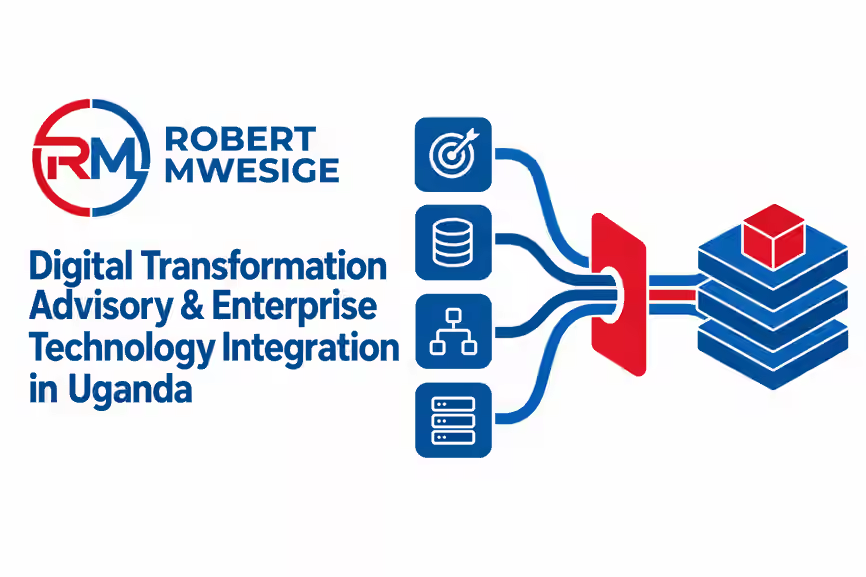
Technology architecture and integration
Applications should exchange the right information securely and avoid unnecessary duplication. Even where Robert is not acting as a technical architect, the transformation brief should define integration needs, ownership, dependencies, scalability, vendor responsibilities and total lifecycle implications.
Leadership, talent and digital culture
Leaders set priorities, remove barriers and reinforce new behaviour. Employees need role clarity, practical digital skills, safe experimentation and responsive support. Performance measures and management routines must reward adoption and service improvement rather than preserving obsolete workarounds. Executive teams can build these capabilities through an executive leadership training programme in the age of AI.
From ambition to adoption
How Robert’s digital transformation consulting process works
The method scales to the organisation and initiative, but the logic remains consistent: define value, diagnose the operating reality, design the future state, implement with governance and measure adoption and benefits.
Frame
Agree the business problem, customer need, strategic outcome, sponsor, scope, constraints and evidence required.
Diagnose
Assess digital maturity, map journeys and processes, review data and systems, and identify root causes and dependencies.
Design
Define the future process, operating model, requirements, governance, roadmap, measures and implementation choices.
Deliver
Coordinate decisions, vendors, pilots, communication, training, transition controls and accountable implementation milestones.
Improve
Measure adoption, service performance, risk and benefits, then refine the solution and strengthen internal ownership.
What the client owns
The organisation owns strategic choices, funding, risk acceptance, access to evidence, staff participation, technology contracts, implementation authority and operating results. A named executive sponsor and capable internal product or process owner materially improve delivery.
What Robert contributes
Robert brings independent diagnosis, structured facilitation, business analysis, people and change judgment, requirements clarity, governance design and implementation focus. He helps decision-makers connect technology choices to real work and measurable value. Organisations that need a focused workshop can use his business facilitation services in Uganda.
Typical digital transformation deliverables
Depending on scope, deliverables may include a digital maturity assessment, executive findings, digital strategy, prioritised roadmap, customer journeys, process maps, future-state workflows, business requirements, evaluation criteria, governance structure, risk register, data definitions, change-impact assessment, communication plan, training plan, adoption dashboard and benefits-realisation framework.
Right-sized transformation
Who can benefit from a digital transformation consultant in Uganda?
Digital transformation should fit the organisation’s strategy, customers, resources, regulatory exposure and current maturity. A startup, NGO, public institution and established company require different roadmaps, controls and implementation rhythms.
Startups and growing SMEs
Growing businesses need scalable processes without purchasing complexity they cannot support. Digital transformation for SMEs may focus on customer records, sales pipelines, inventory, payments, accounting, collaboration, document control, dashboards and management routines. The objective is controlled growth and better decisions, supported where appropriate by a certified business mentor in Uganda.
NGOs and development programmes
Nonprofits need efficient field operations, donor accountability, safeguarding, secure beneficiary information, mobile data collection, knowledge management and timely reporting. A digital roadmap can connect programme delivery, monitoring, finance, HR and partner information while respecting privacy and connectivity constraints. Specialist research, data collection and analysis in Uganda can support larger evidence programmes.
Established companies
Established employers may need to integrate fragmented systems, modernise customer service, automate back-office processes, improve data governance or prepare a major ERP, CRM or AI initiative. Robert can support an internal transformation office or provide independent challenge to a defined programme. Decision-makers can review his consulting work portfolio for examples of adjacent assignments.
Professional and service firms
Consultancies, healthcare providers, education organisations and other service businesses can improve enquiry handling, scheduling, workflow visibility, document management, customer communication, knowledge reuse and reporting. The digital design must preserve professional judgment and client confidentiality. Market-facing firms may connect this work to digital marketing and SEO services in Uganda.
Public and regulated institutions
Public-facing organisations need accessible services, transparent workflows, records, interoperability, continuity and accountability. Robert can facilitate business requirements, stakeholder alignment, operating-model design and change preparation while recognised technical and regulatory authorities provide specialist assurance.
International organisations entering Uganda
Regional and global teams often need to localise platforms, workflows and controls for Uganda without losing enterprise standards. Support may include local process analysis, stakeholder consultation, data and compliance questions, change planning, training and coordination with local specialists. Broader market comparison is available through this guide to locally founded consulting firms in Uganda.
Multidisciplinary leadership
Why work with Robert Mwesige as your digital transformation advisor?
Clients engage Robert when they need a business-led digital transformation consultant who can connect strategy, people, process, customer experience, data, artificial intelligence, communication and implementation.
Technology is treated as an enabler, not the objective
Robert begins with the outcome the organisation must improve. This protects leaders from adopting fashionable tools without a clear problem, owner, process or measure. Vendor-neutral analysis also makes requirements and evaluation decisions more defensible. This is the same evidence-led principle explained in his guide to hiring an independent consultant in Uganda.
People and operating reality are built into the solution
Digital transformation changes roles, decisions, information flows and management routines. Robert’s management and human resource perspective helps teams anticipate resistance, capability gaps, workload, accountability and the conditions needed for adoption. His multidisciplinary background is detailed in the profile of a management, HR and digital transformation consultant.
Advice remains practical and accountable
Robert holds assessed professional standing as a Certified Management Consultant and works from diagnosis through implementation. Clients can review his professional profile, credentials and consulting disciplines before appointment.
What good digital transformation consulting should provide
- A precise business case and measurable outcomes
- Evidence from users, processes, systems and data
- A prioritised roadmap rather than an unranked wish list
- Clear requirements before vendor or product selection
- Named decision, risk, data and benefit owners
- Implementation support that builds internal capability
- Honest boundaries where specialist technical advice is required
Flexible scope, clear accountability
Digital transformation consulting engagement options
The right format depends on the decision, organisational maturity, programme risk, available evidence and internal capacity. Scope and professional fees should be agreed after a short diagnostic conversation.
| Format | Best used for | Typical output | Client commitment |
|---|---|---|---|
| Executive advisory session | A defined investment, system, AI, process or transformation decision. | Clarified issue, options, risks and recommended next steps. | Decision-maker attendance and relevant background information. |
| Digital maturity and roadmap project | Organisation-wide diagnosis, priorities, governance and investment sequencing. | Assessment, executive findings, target state and phased transformation roadmap. | Sponsor, stakeholder access, documents, system information and timely decisions. |
| Defined transformation workstream | Process automation, requirements, data, customer experience, AI or change management. | Agreed analysis, designs, requirements, controls, implementation tools and handover. | Named process owner, working team, evidence and implementation authority. |
| Retained digital transformation advisor | Leadership teams needing continuing independent oversight across several initiatives. | Scheduled advice, portfolio review, decision support, risk challenge and progress oversight. | Executive contact, monthly priorities, reliable reporting and disciplined escalation. |
Digital capability may also require targeted management learning, team workshops and implementation coaching. Robert can combine consulting with practical AI training in Uganda, while larger teams can compare Google Workspace and digital transformation training in Uganda and workplace cybersecurity training in Uganda.
Make a sound appointment
How to choose a digital transformation consultant in Kampala
Choose a consultant who can translate technology into business decisions, diagnose operating reality, challenge assumptions, work across functions and establish measurable accountability. Product knowledge alone is not a transformation method.
Questions to ask before appointment
- How will business value be defined? Require outcomes and measures beyond installation, licences or activity.
- How will the current state be diagnosed? Expect evidence from customers, staff, processes, data and systems.
- Is the advice vendor-neutral? Confirm any reseller, referral, implementation or product relationship.
- Who will do the work? Establish whether the named senior consultant participates directly.
- What exactly will be delivered? Define decisions, documents, workshops, requirements, implementation support and handover.
- How will users and managers participate? Transformation cannot be designed only from the executive office or IT department.
- How will privacy and cybersecurity be addressed? Agree when specialist assessment or legal input is required.
- How will adoption and benefits be measured? Identify baselines, owners, review dates and corrective action.
Robert may be a strong fit when
- You want senior, direct consultant involvement.
- The problem crosses strategy, people, process and technology.
- You need independent diagnosis before selecting a system.
- Your team values clear requirements and practical documentation.
- Leaders are prepared to own decisions, adoption and benefits.
A different provider may be better when
- You require a software developer or systems integrator only.
- You have already selected a product and need licensed technical implementation.
- The assignment is penetration testing or security certification.
- You need formal legal advice on data protection or technology contracts.
- Leadership cannot provide a sponsor, evidence or decision time.
Direct answers
Frequently asked questions about digital transformation consulting in Uganda
What does a digital transformation consultant do?
A digital transformation consultant helps an organisation improve performance by aligning strategy, customers, processes, data, technology and people. Work may include digital maturity assessment, roadmap development, process automation, system requirements, data strategy, AI adoption, governance, change management and benefits tracking.
What is digital transformation in simple terms?
Digital transformation is the deliberate redesign of how an organisation creates and delivers value using digital capabilities. It changes processes, decisions, information, customer experiences, roles and management systems. Buying software without changing how work is performed is technology procurement, not complete digital transformation.
How should a company start digital transformation?
Start with a specific business result, customer problem or operational risk. Establish a baseline, map the current process, identify root causes and determine what must change in roles, data, controls and technology. Then prioritise a manageable pilot with an accountable sponsor, users and measurable success criteria.
Can Robert prepare a digital transformation strategy and roadmap?
Yes. The scope can include a digital maturity assessment, stakeholder consultation, strategic outcomes, transformation principles, prioritised initiatives, dependencies, governance, capability needs, indicative sequencing, risks and measures. The roadmap should remain realistic about budget, internal capacity and implementation readiness.
Does digital transformation require replacing every system?
No. Existing systems may remain useful if processes, configuration, integration, data quality and user practice improve. Replacement is justified when the current technology cannot meet essential requirements, carries unacceptable risk or costs more to sustain than a realistic alternative.
Can small businesses afford digital transformation consulting?
Yes, when the scope is proportionate. An SME may begin with one high-value process, a concise digital maturity review or a practical technology-selection decision. The objective is to prevent avoidable spending, improve control and create a scalable foundation rather than copy the architecture of a large enterprise.
How does artificial intelligence fit into digital transformation?
AI can assist analysis, knowledge retrieval, drafting, prediction, customer support and workflow decisions, but it needs a valid use case, suitable information, verification, human accountability and privacy controls. AI adoption should form part of the wider process, data and governance strategy rather than operate as an isolated experiment.
How long does a digital transformation project take?
Duration depends on scope, maturity, systems, process complexity, stakeholder availability, procurement and implementation capacity. A focused advisory review may take days or weeks, while an organisation-wide roadmap or multi-workstream programme may extend over several months. Robert confirms milestones and client dependencies in the proposal.
How much does digital transformation consulting cost in Uganda?
Professional fees depend on the decision complexity, organisational size, locations, evidence required, number of processes, stakeholder consultation, deliverables and implementation support. After a diagnostic conversation, Robert can recommend an advisory session, fixed-scope project, workstream assignment or retained consulting arrangement.
What should we prepare for the first consultation?
Prepare a concise description of the business problem, desired result, affected customers or teams, current systems, known constraints and required timing. Useful documents may include a strategy, process description, customer feedback, organisation chart, system list, project proposal, performance report or vendor document.
Uganda digital transformation reference authorities
Organisations should confirm current requirements and technical guidance with the responsible Ugandan authorities and appropriately qualified specialists.
Start with the business result
Discuss your digital transformation challenge directly with Robert Mwesige
Share the customer need, process problem, technology decision or strategic result you need to address. Robert will help clarify whether a focused advisory session, digital maturity assessment, transformation roadmap, defined workstream or retained advisory arrangement is the right next step.
You can also review Consulting Services in Uganda, return to the Robert Consulting Homepage, or Contact Us.